
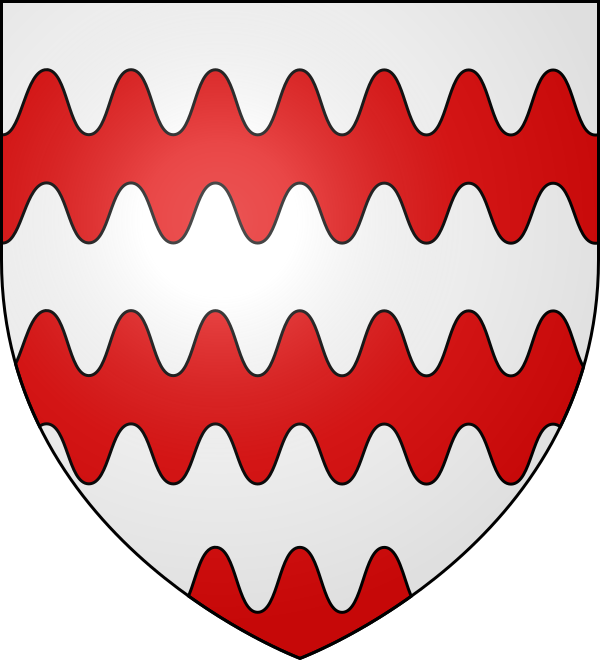
Alix and the Lion of Rochechouart


Above the meeting of the Graine and the Vayres, in the Limousin, rises the castle of Rochechouart, long the fief of the vicomtes of the same name. From the town one climbs to its towers across a quiet square; from the valley one sees it resting on its spur of grey rock. One of these towers bears a name of its own: the Lion Tower, after the small stone beast set into its wall. It has been there for centuries, and it keeps, they say, the memory of a lady who was thrown to a real lion and whom the beast would not touch.


1 The castle on the rock
The history of the place begins around the year one thousand, when the vicomtes of Limoges fortified a rocky spur above the Graine. Of that first fortress only the gatehouse with its drawbridge remains, still keeping one of the towers of the thirteenth century. The keep goes back to the twelfth century; most of the building, with its courtyard and its gallery on twisted columns, dates from the fifteenth. For eight centuries the vicomtes of Rochechouart, vassals of the count of Poitiers, reigned over this rock.
Their name runs through the whole history of France. Aymeric IV followed Godfrey of Bouillon on the first crusade; Jean I fell at the battle of Poitiers in 1356 defending King John the Good; another Rochechouart was a companion of Jeanne d’Arc, and later Françoise-Athénaïs, of the Mortemart branch, became under the name of Madame de Montespan the favourite of Louis XIV.
But the rock itself has a far older history. The grey stone on which the castle rests is a breccia, born some two hundred million years ago from the fall of a meteorite. The impact opened a crater about twenty kilometres across and released an energy estimated at fourteen million times the bomb of Hiroshima. Rochechouart was the first impact structure recognised in the world by the marks of the shock in the rock alone, with no visible circular relief. The town, its church and its castle are built of this stone fallen from the sky.
2 Alix and the lion
The legend ties itself in 1205, under the vicomte Aymeric, who had the castle built of which the keep remains. His wife Alix passed for a lady of great beauty and of greater virtue still. The steward of the castle conceived a violent passion for her; she refused him. To take his revenge he went to the vicomte and reversed the parts, accusing the lady of the unfaithfulness he had himself dreamed of.
Mad with rage, Aymeric had Alix thrown into the dungeon of a tower where a lion was kept, brought back, they say, from an expedition to the Holy Land. They let the days pass, then opened the door, sure of finding only bones. Alix was alive, and the lion slept at her side. No more was needed to convince the vicomte of her innocence. In the lady’s place he had the steward shut in, whom the starving beast devoured without delay.
In memory of the marvel, Aymeric is said to have had a stone lion set into the wall of the tower of the oubliettes, called the Lion Tower ever since. It must be said plainly: the tale was not written down until the nineteenth century, by the Abbé Duléry, in his history of Rochechouart of 1855, and the chroniclers waver even over the number of the vicomte. The very existence of Alix is not established. But the tower is there, and the stone lion as well.
3 What the walls keep
The castle one visits today is no longer a fortress. After the Hundred Years’ War it was rebuilt as a pleasure house; in the Renaissance the Rochechouart-Pontville had its halls painted. In the hunting hall, polychrome frescoes from the beginning of the sixteenth century unroll a great stag hunt along the walls; the hall of Hercules keeps grisaille paintings from the middle of the century. During the Revolution people tried to pull the building down; they only managed to raze the tops of two towers.
Bought by the department in 1836, restored under Napoleon III to house the sub-prefecture, the castle has held since 1985 the museum of contemporary art of the Haute-Vienne, where the collection of the Dadaist Raoul Hausmann stands beside works by Giuseppe Penone or Christian Boltanski. One climbs up to it for the art of today; one stops before the Lion Tower for the history of yesterday.
Around the rock now stretches the national nature reserve of the impact structure, created in 2008, the only one in France devoted to the remains of a meteorite strike. So everything here holds in the stone: the memory of a lion fixed to the wall, the virtue of a lady whom no archive confirms, and, deeper still, the memory of a fire that fell from the sky two hundred million years ago. Rochechouart keeps its frescoes, its rocks and its legend, in no hurry to divide the true from the beautiful.
- Saint Leonard and the Quintaine of Saint-Léonard-de-Noblat · Saint-Léonard-de-Noblat
- Valérie, the Maiden Who Carried Her Head · Limoges

Heimweer.be · Europees Erfgoed Bewaard

