
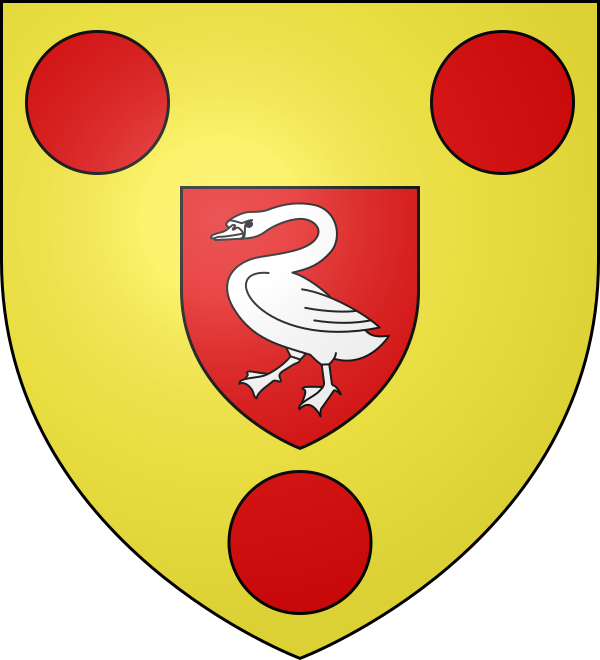
Our Lady of Boulogne and the Boat Without a Crew


Anyone looking at Boulogne-sur-Mer from the sea sees the dome first. It rises high above the walled upper town, above the ramparts and the four gates, and the fishermen of the largest fishing port in France steered by it for generations. Under that dome a story is kept that is older than the stones themselves: the story of a boat that one day drifted into the harbour, with no sail, no rudder and nobody on board.


1 The boat without sail or rudder
Tradition sets the scene in the year 636, in the days when the Boulonnais belonged to the Frankish kingdom of King Dagobert; other accounts say 633, and others again 638 or 639. There is no choosing between them, for the oldest written versions go back no further than the end of the Middle Ages.
The story runs like this. At the mouth of the Liane, where the little river runs into the Channel, a small boat was seen that seemed to come from nowhere. No sail, no rudder, no crew, and yet it made straight for the bank, as though pushed by hands that nobody could see. Whoever looked inside found a wooden image of the Virgin Mary with the Child on her left arm.
At that same moment, tradition says, something happened up in the town. In the chapel on the hill, where the faithful were gathered, the Virgin appeared in person. She spoke to them, called herself the advocate of sinners and the source of grace, and asked them to have a church built in her name. When the people ran down the slope to the water, the little boat was still there.
They carried the image up and set it in the chapel, on the spot where tradition says a Roman temple had once stood. So began one of the oldest pilgrimages in north-western Europe.
2 The statue in the boat and the kings
The boat has never left the statue since. Our Lady of Boulogne is seldom shown alone: she stands or sits in a little vessel, usually with two angels steering it. The people of Boulogne call her the Vierge nautonière, the Virgin who sails, and on the great feasts the image was carried in procession through the streets on just such a little boat.
The pilgrims came on foot, from all over France, from Flanders and from England. In the Middle Ages Boulogne ranked among the busiest pilgrimages of the kingdom, alongside Le Puy-en-Velay, Rocamadour and Chartres. Crusaders had their swords blessed here before setting out for Jerusalem. About 1090 Ida of Boulogne, the mother of Godfrey of Bouillon, had a stone church with a Romanesque crypt built. In 1308 the marriage of Edward II of England and Isabella of France was celebrated here. And in April 1478 Louis XI handed over the lordship of the county of Boulogne to the Virgin herself.
The statue lived through more than most people do. In 1544 the soldiers of Henry VIII carried it off to England; it took years to bring it back. In 1567 Huguenots sacked the church and it was hidden in a well at the castle of Honvault; only in 1607 did it come to light again. In December 1793 the end came: revolutionaries threw it on the fire. All that survived were two fragments — pieces of a finger, tradition says — kept today in reliquaries in the basilica. Five years later the old cathedral itself was sold and pulled down.
3 The dome, the crypt and the procession today
Boulogne was left without a church and without an image. What it did have was a priest with a plan that everyone thought far too large. In 1820 Benoît-Agathon Haffreingue bought up the ruins of the demolished cathedral, and from 1827 he began to build: he drew the plans himself and directed the works until 1857. The dome, nearly a hundred metres high, was finished in 1863; on 24 August 1866 the church was consecrated, and in 1879 Pope Leo XIII raised it to the rank of basilica.
While digging, the workmen struck in 1827 upon something nobody suspected was still there: the old crypt, a hundred and twenty-eight metres long and forty-two metres wide, filled in at some point and then forgotten for centuries. It is one of the largest in France. Whoever goes down passes Roman remains, a Romanesque hall, Gothic arches and the reliquary of the Holy Blood. Since 2015 it has been open to visitors again.
Above ground the rest held firm as well. The ramparts raised by Count Philip Hurepel between 1227 and 1231 still follow the outline of the Roman fort; four gates lead in, and in the niche above the Porte des Dunes a Virgin stands once more in her boat. Below, the fleet lands its catch in the largest fishing port in the country. And every year, on the second Sunday after 15 August, the procession takes to the streets again for five days — a date chosen long ago because the deep-sea fishermen came home just then.

Heimweer.be · Europees Erfgoed Bewaard

