
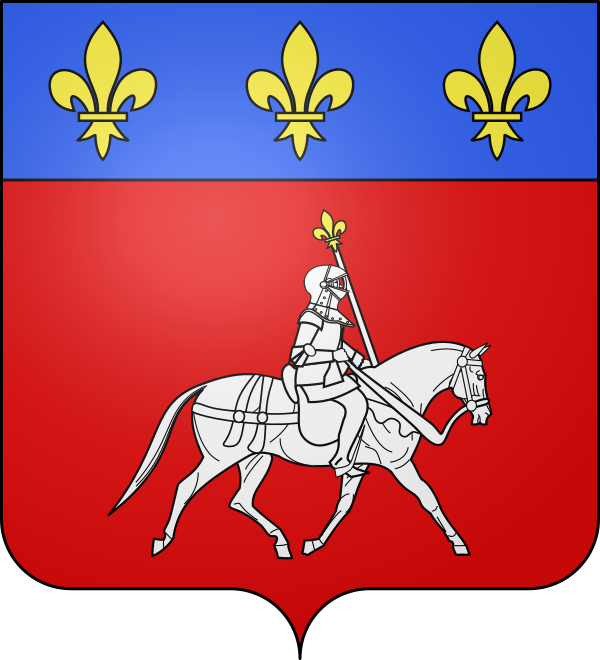
The Knight’s Dream and the Angels’ Share


On the bank of the Charente, between chalk vineyards and brown tiled roofs, the town of Cognac has lived for four centuries on a wine that nobody drinks. It is burned twice, shut up in oak casks and then left alone for years. The country says that all of it began with a bad dream, one night, in the house of a knight from Segonzac.


1 The knight’s dream
They called him the chevalier de la Croix-Maron, a lord in the Charente, in the country around Segonzac. He was, tradition says, a very pious man, one of those who think of their soul before blowing out the candle. One night he dreamed that the devil had come to fetch that soul. The Evil One had thrown him into a great cauldron and was patiently stirring the fire beneath it, as one brings linen to the boil.
But the knight’s faith held. After a first boiling the soul came whole out of the cauldron, and the devil, put out, had to stoke the fire again. «Once is not enough,» he growled, «it must be twice.» The knight woke drenched in sweat, with a thought that never left him again: what the devil did with souls could be done with wine. He had his own run a second time through the still, and out of that second heating, the legend says, cognac was born.
The fine story must not hide the other one. Double distillation did not come from a dream but from trade and taxation. Already in the sixteenth century Dutch ships came up the Charente for the white wine of the district; low in alcohol, it travelled badly and often arrived sour. People began to burn it so that it would stand the sea: that is brandewijn, burnt wine, from which English brandy comes. At the beginning of the seventeenth century single distillation took hold there, because concentrated spirit, watered down again on arrival, fitted into fewer casks than wine and cost less in freight and storage. The second heating came afterwards. The dream explains less than it consoles.
2 Twice through the fire
The wine that goes into the still has nothing amiable about it. It comes above all from ugni blanc, sharp and light, eight to eleven degrees, still cloudy with its lees. Here they call it the boiler wine: it is not made for the table, it is made for the fire.
The alambic charentais is all of red copper: a boiler on its furnace, a head shaped like an onion, a swan neck plunging into the coil and the basin of cold water. The first heating gives the brouillis, milky, at around thirty degrees. It goes back into the boiler for the bonne chauffe, and there everything is decided: the distiller sets aside the heads, keeps the heart, saves the secondes for the next heating and lets the tails go. For this he has only his alcoholmeter, his nose and long habit. The heart runs out as clear as water, between sixty-eight and seventy-two degrees.
The distilling season falls in winter, in cold nights, and the law stops it on 31 March following the harvest. The wine grows on chalk soils that the geologist Henri Coquand mapped from 1860 onward, and which since 1938 carry six crus: Grande Champagne, Petite Champagne, Borderies, Fins Bois, Bons Bois and Bois ordinaires. The first of them, Grande Champagne, has Segonzac for its chief town — the very country of the knight.
3 The angels’ share
The heart of the heating then disappears into oak. The cellar masters choose, according to the grain they are after, the wood of the Limousin or that of the forest of Tronçais; the casks are new or have never held anything else. For two years at least, and usually far longer, the spirit breathes through the wood, takes up its colour and loses some of its strength.
For oak is not watertight. Every year a part of the cask goes off into the air: about two per cent of the stock, more in the airiest storehouses, which for the district comes to the equivalent of more than twenty million bottles a year. This is called the angels’ share, and the word is said to come from the alchemists, who called volatile substances angels. What the cask lacks is made up from another cask of the same origin; that operation is called ouillage.
The vapour is not altogether lost. It feeds a microscopic fungus that settles on walls, roof tiles and tree trunks and blackens them like a very fine soot. Charles Édouard Richon described it in 1881 under the name Torula compniacensis; today it is called Baudoinia compniacensis, after Compniac, one of the old names of Cognac. The authorities could read those black walls to track down clandestine stills. Above the quays rises the castle of the Valois, where Francis I was born in 1494. To him, or to Henry IV, this phrase about the river is attributed: «the Charente is the prettiest little stream in my kingdom».
 Vie FelineKattengedrag en vachtverzorging
Heimweer.be — Europees Erfgoed Bewaard

