
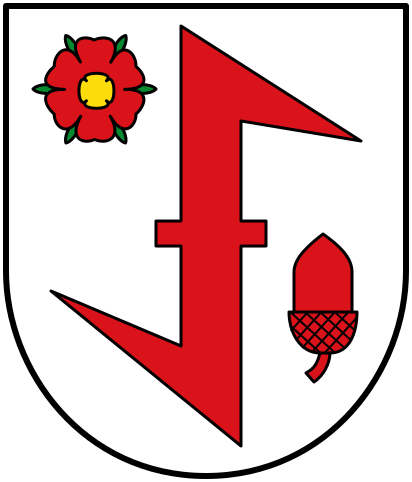
The Rock Church of Idar-Oberstein


Whoever takes the stairway up from the market square of Idar-Oberstein — a good two hundred steps — arrives not at a church door but at a hole in the rock. A tunnel leads into the mountain, and behind it stands the church: built into a niche of the cliff, the steep wall above it, the roofs of Oberstein far below. The Felsenkirche is the emblem of the town. Two accounts of its origin run side by side: a legend everyone in the Nahe valley knows, and a building history that is told far less often.


1 The church in the rock
The lords vom Stein are first mentioned in 1075. Their oldest seat lay above the later church, on Burg Bosselstein, known locally as the Alte Schloss; the castle appears in the charters in 1197. When the family split in the thirteenth century, the Daun-Oberstein line built a second castle right beside it around 1320: Schloss Oberstein, the Neue Schloss. It remained the permanent residence of the counts of Daun-Oberstein-Falkenstein until 1624. French troops blew up its four roundels in 1697, the rest burned out in 1855, and restoration has continued without a break since 1981.
Between the two castles and the little town lies the rock niche. It was not hewn out but formed naturally: a cavity of several thousand cubic metres. In it Wirich IV of Daun-Oberstein had the church built between 1482 and 1484, on the foundations of older structures. The position has exacted its price. Falling rock destroyed the late Gothic glass windows in 1742, and in both 1742 and 1858 deep structural rebuilding was needed. The tunnel through which one now enters is young: it was cut into the rock only in 1980 and 1981. Since 2003 a viewing platform behind the church has been open.
2 The legend of the two brothers
Tradition explains the church quite differently. On the old castle above the rock lived two brothers of the house of Oberstein, Wyrich and Emich. Both loved the same woman, the castle maiden Bertha von Lichtenberg, and when one learned of the other’s betrothal, jealousy turned to violence. In a sudden impulse he pushed his brother from the castle, and the brother did not survive the fall.
What follows is a story of penance. The killer confessed the deed to a churchman — in one version an abbot, in another a bishop — and was given as his penance that he must build a church with his own hands on the spot where his brother had come down. In several tellings he first wanders restlessly for years, or joins an expedition to the Holy Land, and begins only after his return. With hammer and chisel he hollowed out the rock. As the work went on a spring rose there; tradition places it behind the altar and says that it still runs. At the consecration he sank down dead before the altar, and killer and victim are said to have been buried together in the church.
3 What the sources say, and the town of agate
The parish itself says it openly: the legend is not history. No Bertha von Lichtenberg can be traced anywhere, and there is no trace of a fratricide at Schloss Oberstein. Burg Lichtenberg in the Westrich was moreover no fief of Trier, as the legend has it, but was built in or shortly before 1214 by Count Gerlach of Veldenz. The cavity in the rock is natural; cutting out such a space with hammer and chisel was then technically almost impossible and does not agree with the building evidence. The version with the cat in the boot is told in the same way of the Schmidtburg near Bundenbach and of Burg Manderscheid in the Eifel: a migratory tale.
And yet something real lies underneath. A killing within the kindred is indeed recorded: at the end of 1328 or the beginning of 1329 a Wirich of Daun was slain in his bed by a distant cousin of the Bossel zu Stein family. His stepbrother Cuno had left Oberstein after family quarrels and become a knight of the Teutonic Order — not in Palestine, but in Prussia and Livonia — and was fetched back after the murder to govern. Names such as Wirich and Emich recur again and again in the house, which explains how they found their way into the legend.
Below lies the town that lives from stone. Agate and jasper sat in the rock around Idar and Oberstein, and the trade of agate cutter arose early. The grinding mills stood on the Idarbach, because the Nahe burst its banks too often; the goldsmiths, who needed water, settled from about 1660 precisely on the Oberstein bank of the Nahe. When the local seams ran out around the middle of the eighteenth century, Brazilian agate was worked instead. Today the German Gemstone Museum in Idar shows more than ten thousand exhibits, and at the Steinkaulenberg one enters the only gemstone mine in Europe open to visitors.

Heimweer.be · Europees Erfgoed Bewaard

