
The Founding of Lehnin Abbey


Margrave Otto I of Brandenburg (1128-1184), son of Albrecht the Bear, founded in 1180 the Cistercian abbey of Lehnin. By tradition he dreamed of a hind that laid her head down on a spot; there he built the abbey. Lehnin was for 350 years the burial place of the Ascanian margraves.


1 The hunt and the dream
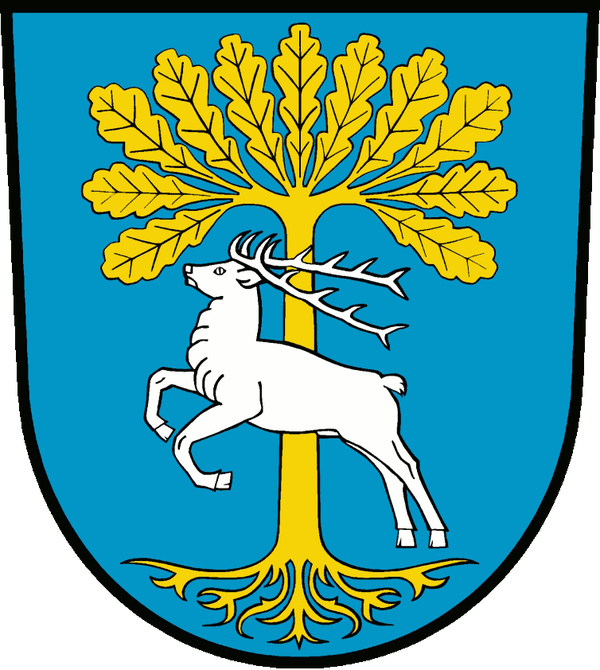
Otto I, son and successor of Albrecht the Bear, was 52 in 1180. He was hunting in the Brandenburg forest of Zärten with twelve noble companions. On a May morning he saw a white hind, unusually white as an albino. Three hours he chased her. She ran before him, seemed to look at him at every turn. On a glade by a pond she laid her head on her forelegs and lay still. Otto neared, could have killed with one spear-cast, did not. He looked at her for ten minutes. She looked back, fearless, with one tear in each eye. Otto knew: this was no hunting game. This was a sign.
2 The abbey
Otto did not draw the sword. The hind rose, went into the pond, drank, vanished in the reeds. Otto knelt where she had lain: «Here I build an abbey in honour of her who did not flee me. Cistercians, for they are the simplest. Lehnin it shall be called, from Old Slavic lan = hind.» Twelve Cistercian monks from Sittichenbach came in 1183. The abbey church was begun 1190, finished 1262. Otto died in 1184, four years after the founding, buried in Lehnin as the first Ascanian. His son, grandson and nine further Ascanian margraves followed over two centuries. In 1542, with the Reformation, Lehnin was dissolved; in 1911 again a (Lutheran) monastic community. The abbey church stands. The legend-hind is shown on a stained-glass window of 1267 still preserved. Tradition: «A margrave who lays down his hunting spear for a hind builds an abbey. A hind who lays down her head for a margrave gets an abbey. Without the hind no Lehnin; without Otto no Brandenburg counts under one roof. Both needed.»
 Vie FelineKattengedrag en vachtverzorging
Heimweer.be — Europees Erfgoed Bewaard

