
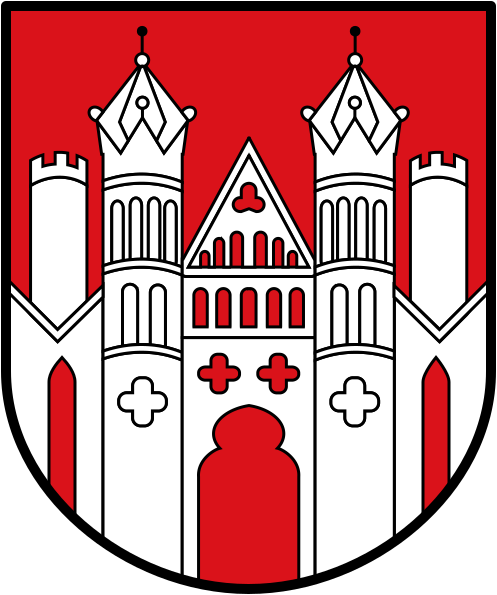
Saint Vitus and the Westwork of Corvey


On the river Weser, just outside Höxter in eastern Westphalia, stands a church front of a kind that survives nowhere else in the world: the Carolingian westwork of Corvey, built between 873 and 885. Behind those sandstone walls lies the story of an abbey that came from Picardy, of a saint fetched from Paris, and of a people who, tradition says, converted only once their own protector had arrived.


1 Nova Corbeia on the Weser
In 815 or 816 the half-brothers Adalhard and Wala, abbots of the famous monastery of Corbie in Picardy, founded with the consent of Emperor Louis the Pious the first monastery in the land of the Saxons. The first site, Hethis in the Solling forest, proved too cold and too barren; the harvests failed year after year. On 26 September 822 the community moved to a flat bend of the Weser near the settlement of Höxter. The monks called their new house Nova Corbeia, the new Corbie. From that name the later Corvey was worn down.
The choice was as political as it was religious. Charlemagne had converted the Saxons by the sword for thirty years; his son wanted to finish the work with books and liturgy. An imperial privilege of 27 July 823 made Corvey free and wealthy. The monks brought manuscripts, seed grain, Frankish chant and a school. Yet for the Saxon peasant the new church long remained the church of the victor — a faith imposed rather than chosen.
2 The saint who came from Paris
What was missing, Abbot Warin fetched in 836. From the abbey of Saint-Denis near Paris he obtained the relics of Saint Vitus, a young martyr said to have died in Sicily around 303 under the Emperor Diocletian. A long procession carried the bones northward. The ninth-century Translatio sancti Viti, written down at Corvey itself, describes that journey step by step and reports healings along the way: the lame who rose, the blind who saw again.
From the arrival onward, tradition says, everything changed. Only with Vitus did the Saxons receive a protector of their own — not a Frankish saint pressed upon them, but one who lived in their land and spoke for them. Widukind of Corvey, a monk of this house, wrote a good century later in his history of the Saxons that with the coming of Vitus the fortune of the Franks sank and that of the Saxons rose. A fine sentence, but no neutral report: here a house monk praises the saint of his own abbey.
What is certain is that the translation took place and that it made Corvey one of the richest abbeys of the empire. That the Saxons only then converted in earnest is a reading by chroniclers, not a measurable fact. Vitus himself later acquired a curious career: he was invoked against cramps, falling sickness and the medieval dancing mania. That affliction still bears his German name — Veitstanz, Saint Vitus’s dance.
3 The westwork and the Odyssey
Between 873 and 885 the abbey raised a monumental structure at the west end of its church. That westwork still stands: a block of sandstone with two towers and, inside, a lofty pillared hall above the entrance. It is the only surviving Carolingian westwork in the world, and since June 2014 it has stood on the UNESCO World Heritage list together with the remains of the surrounding civitas.
The strangest discovery came only in the twentieth century. In the upper storey, beneath layers of plaster, fragments of ninth-century wall paintings emerged, among them a scene from the Odyssey: Odysseus fighting the sea monster Scylla. Ancient mythology, painted in a Christian abbey church — nothing comparable survives north of the Alps. Why that Greek hero hangs there nobody knows for certain; the usual reading, worked out by the art historian Hilde Claussen, sees in him an emblem of the believer who withstands danger and temptation.
The abbey survived fire, war and Reformation, but not secularisation: in 1803 Corvey was dissolved and the complex became a princely residence. In the Princely Library, some seventy thousand volumes, August Heinrich Hoffmann von Fallersleben served as librarian from 1860 until his death in 1874 — the poet of the song that later became the German national anthem. He lies buried beside the abbey church, a few steps from the westwork where Odysseus has been fighting Scylla for eleven centuries.

Heimweer.be · Europees Erfgoed Bewaard

