
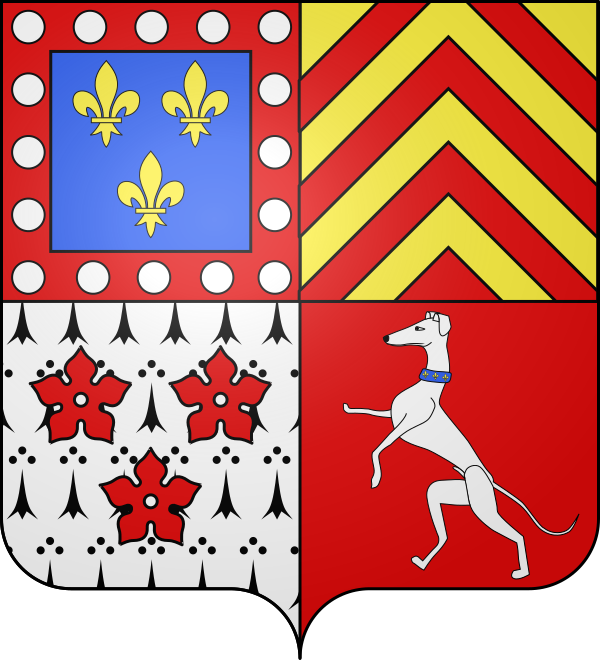
The stronghold William the Conqueror never took


Above the Erve, on a rocky spur that drops seventy metres to the river, stands the cité of Sainte-Suzanne. From 1083 to 1086 the army of William the Conqueror lay at its foot, in an earthwork the country still calls the Camp des Anglais. The king had taken Le Mans, he had taken Fresnay, he had taken Beaumont. This one rock he did not take.


1 The tower on the rock
About the middle of the eleventh century the viscounts of Beaumont raised a rectangular residential tower on the point of the rock. It measures 19.45 by 15.50 metres, its walls are three metres thick, and it ranks among the oldest stone keeps in France. Below lay the cellar, above it the hall of reception, at the top the lord’s own chamber. Set into the thickness of the walls are latrines, two fireplaces, a sink that drains nowhere, and, hidden in the north wall, a vaulted passage reachable only through a vertical shaft. They call it the treasure room; there, most likely, lay the charters of the house of Beaumont.
Why a lord of Maine built like that, the map explains. When Count Herbert II of Maine died without an heir in 1062, William, Duke of Normandy, held the county to be his. The people of Maine thought otherwise. They rose in revolt, and when William came back from England with an army in 1073 he took Fresnay, Beaumont and Sillé and subdued Le Mans.
Hubert II of Beaumont, viscount of Maine, thus lost everything but his last castle. In 1083 he shut himself into Sainte-Suzanne with his wife Ermengarde of Nevers, gathered a picked company of knights about him, and from there harried the king’s men as far as Le Mans. Then William came himself.
2 The camp in the valley of Beugy
William did not attack the hill head-on. The chronicler Orderic Vitalis, monk of Saint-Évroult, whose father had crossed to England with William, writes that the king could not besiege the fortress: the rocks and the thickness of the vines that surrounded it on every side made it inaccessible, and he could not shut the enemy in either, for the besieged boldly kept their ways out open. So the king did what he had done before at Brionne and Domfront. In the valley of Beugy, eight hundred metres north of the town, he had a fortified camp thrown up and put a garrison in it under Alan the Red, count of the Bretons.
It was two rectangular earthen enclosures with ditches, together a good two and a half hectares. The southern flank looked straight at Sainte-Suzanne: in plain sight, but out of range of the weapons of the day. For four years little happened but skirmishes, and those generally went in favour of the besieged. Knights came to Hubert from Aquitaine and Burgundy; captured Normans and Englishmen fetched ransoms, so that the castle grew richer on the siege than the besiegers did.
On 18 November 1085 a beardless boy in the bushes beside the road shot Richer de l’Aigle beneath the eye. Dying, the knight begged his furious companions to let the boy go. And in the country they still tell of the white mule that carried flour up from the Grand-Moulin through an underground passage.
3 What the chronicle says and what pride added
In 1086 it ended. The Normans in the camp saw that they could master Hubert neither by valour nor by luck, and they opened talks. Hubert agreed, crossed the Channel under safe conduct and was kindly received by William. The king gave him back the lands of his fathers, and that peace held. William died at Rouen on 9 September 1087.
What Orderic Vitalis reports, then, is this: no assault that carried the walls, no surrender, but a camp, dead knights and a siege broken off. The famous sentence that Sainte-Suzanne is the only stronghold William the Conqueror never took is not in him. That formula was made later, in Maine and in England. The camp remained, the tower remained, and the sentence was added.
The earthwork in the wood has been a listed monument since 28 July 1937; the commune bought it in 1989 and opened it to walkers. Inside the walls of the cité, behind the porte du Guichet and under the tour du Guet, Guillaume Fouquet de la Varenne, minister of Henri IV, had a dwelling built against the old rampart between 1608 and 1613. And the lady of Sainte-Suzanne? She is no warlike châtelaine but Saint Susanna herself, whose relics are said to have been brought here in the tenth century. She gave the little town its name, and the betrothed still ask her image in the church for a good marriage.
- The Hawthorn of Évron · Évron

Heimweer.be · Europees Erfgoed Bewaard

