
The Summer of Saint Martin


At the meeting of the Loire and the Vienne, at the bec de Vienne, lies Candes-Saint-Martin, one of the most beautiful villages of France. Its houses of white tuffeau and its slate roofs climb the hillside around a collegiate church that looks like a fortress. Here, in a cell whose place is still marked by a stone, Martin, bishop of Tours, died on a day of November in 397. What followed his death the people of the country still tell : a boat went up the Loire by night, and the banks of November covered themselves with flowers.


1 The parish at the bec de Vienne
The site is a crossroads. Already in antiquity a settlement rose where the territories of three Gaulish peoples met, the Turones, the Pictones and the Andecavi, at the point later called the Borne des Trois-Évêchés. The name Candes itself comes from the Gaulish Condate, which marks the confluence of two watercourses. The place was, from of old, a border and a passage.
Around 387 Martin of Tours came to evangelise this population and founded here one of the first parishes of the Touraine, at the western edge of his diocese ; tradition holds that he threw down a pagan temple there. Ten years later, in October 397, he returned to Candes to settle a quarrel between clerics. He was about eighty-one years old, exhausted, and he knew this journey might be his last.
He brought back peace, but he no longer had the strength to leave. Martin died at Candes on 8 November 397. Sulpicius Severus, who had known him, tells of that death in a letter to his mother-in-law Bassula ; it is an almost contemporary testimony. The rest, the extraordinary part, would be written down two centuries later.
2 The taking of the body
For the death of Martin was not the end of the story. Scarcely had he given up the ghost when two towns disputed his remains. Poitiers claimed him, where he had founded the monastery of Ligugé and served bishop Hilary ; Tours wanted him, whose bishop he had been. According to the tradition handed down by Gregory of Tours, the men of Tours carried the day by a ruse : while the people of Poitiers slept, they passed the body out through a window.
They loaded it onto a gabarre, one of those flat-bottomed boats that then carried all the trade of the river, and went up the Loire towards Tours. Candes lies downstream of the city : they had therefore to row against the current, by night, with the body of the saint for cargo. On the quays one still sees there, it is not hard to imagine.
It is Gregory of Tours who, two centuries after the events, sets down this whole scene that Sulpicius Severus did not know : the taking of the body, the journey upstream, the wonder of the flowers, then the funeral. So the legend joined itself to history, as it often does, in the interval of memory.
3 The summer of Saint Martin
The wonder, here it is. As the procession passed on the Loire, between Candes and Tours, it is said that the bushes and the trees covered themselves with flowers in the middle of November, as if autumn, for a moment, became summer again. From that miracle a phrase was born that French still uses : the summer of Saint Martin, those few mild, sunny days that sometimes return around 11 November, after the first frosts.
On that day, 11 November 397, Martin was buried at Tours ; that is why the Church keeps his feast on that date, and not on the day of his death. Honesty requires us to say that this warm spell has nothing miraculous about it : in 1914 the astronomer Camille Flammarion saw in it only a stirring of the air currents, autumn throwing, as he put it, a bridge between summer and winter. The fine weather existed before the legend ; the legend gave it a name and a date.
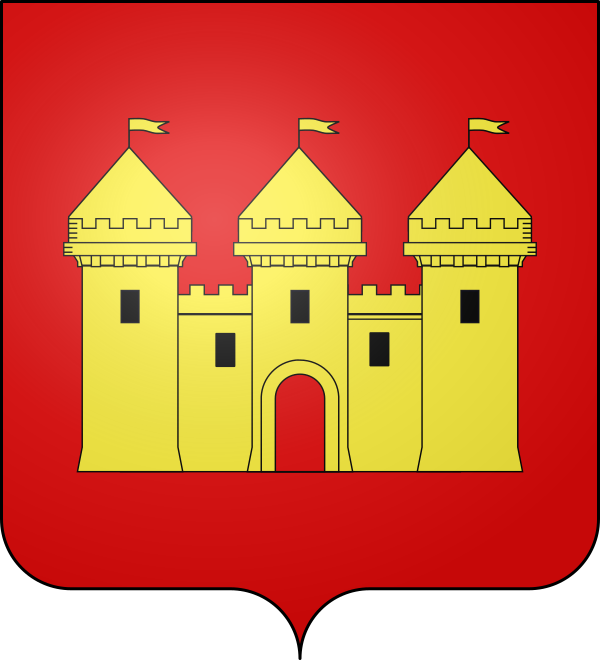
Candes itself has kept the place. On the site of the cell where Martin died there rises, since the end of the twelfth century, a collegiate church in the Angevin Gothic style, listed as a monument historique since 1840, with its fortified porch flanked by crenellated towers. A narrow passage leads from the transept to the chapel of Saint Martin, where a stone marks the place of the death, while a stained-glass window tells of the taking of the body. Outside, the Loire and the Vienne slowly mingle their waters, and every autumn, if the sky is willing, the summer of Saint Martin returns.

Heimweer.be · Europees Erfgoed Bewaard

