
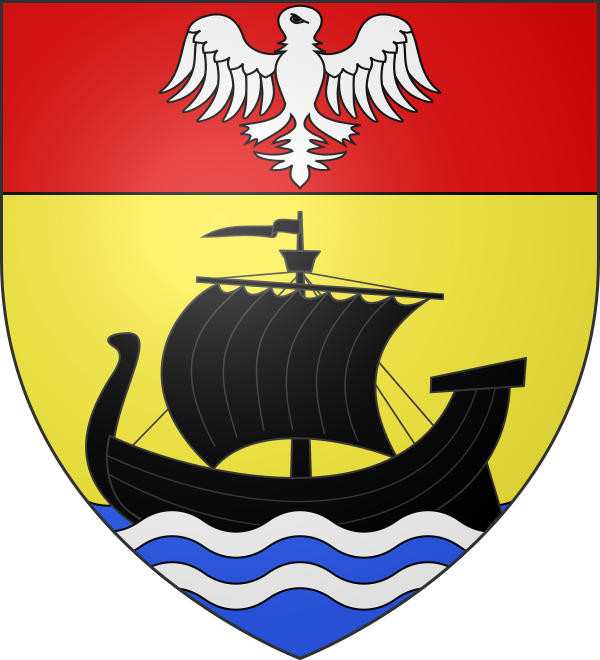
The Three Children in the Salting Tub and the Finger of Port


Some fifteen kilometres south of Nancy the Meurthe runs through a small town of stone and brick that bears the name of a kindly saint: Saint-Nicolas-de-Port. You come to it across the plain, and suddenly, above the low roofs, two towers rise more than eighty metres high, crowned with onion domes of lead. A cathedral without a bishop, set down there as if by mistake. It is no mistake. It stands here because a knight of Lorraine brought a very small bone back from Italy, and because a whole people has been singing for centuries about three children a butcher had salted down.


1 They went gleaning in the fields
Every child in Lorraine knows the lament: «Ils étaient trois petits enfants qui s’en allaient glaner aux champs», there were once three little children who went gleaning in the fields. Evening falls, the road is lost, they knock at a butcher’s door and ask for a bed. The man opens, lets them in, kills them, cuts them up and puts them in the salting tub, the vat in which meat is kept for the winter. Seven years go by, says the song, and nobody knows a thing.
Then Saint Nicholas comes across that same field and asks for supper. He is offered ham, he will not have it; veal, he will not have it. He asks for the salted meat that has lain seven years in the tub. At those words the butcher flees up the stairs. The bishop steps to the vat, stretches three fingers above the salt, and the three children sit up. The first says he has slept well, the second says the same, and the third answers that he thought he was in paradise.
Honesty demands it be said: this song does not belong to Saint-Nicolas-de-Port. It is sung in Lorraine, but just as much in Picardy, Normandy and Burgundy, and as far as Flanders and the Netherlands, where Sinterklaas has versions of his own. Every country has put its own words to it. Here it is simply more at home than elsewhere.
2 The finger bone from Bari
The second story is shorter and stranger, because it begins with a theft. At the end of the eleventh century — tradition wavers between 1087 and 1098 — a knight of Lorraine named Aubert de Varangéville was at Bari in Apulia, where the bones of Saint Nicholas had lately come to rest, carried off from Myra by Italian sailors. Aubert brought back a phalanx, a small bone from a finger of the saint’s right hand. A sailor who had made the crossing told the tale, and from that telling comes all the rest.
The relic was laid not in Aubert’s own village but on the far side of the Meurthe, at the harbour of Varangéville, a hamlet of boatmen and toll collectors called simply Port. A first church rose there about 1093, and the name of the town followed the name of the saint: Portus Sancti Nicholai as early as 1234, later Saint-Nicolas-de-Port.
The pilgrims came, and they never stopped coming. It is told that Cunon de Linange, lord of Réchicourt, a prisoner in the East about 1240, fell asleep in his cell after praying to Saint Nicholas and woke on the church square, his chains falling away of themselves. Jean de Joinville had the silver ship carried here in 1254 that Queen Margaret of Provence had vowed in the storm. Jeanne d’Arc is said to have prayed here in 1429 before setting out for the dauphin. Nicholas had become the patron of the people of Lorraine.
3 The vow of René II and the candles of December
On 5 January 1477, in the snow before Nancy, Duke René II of Lorraine and his Swiss allies broke the army of Charles the Bold. The duke of Burgundy lost his life there and Lorraine kept its independence. René II ascribed the victory to the patron of the duchy and wanted for him a building to match his gratitude.
The works opened in 1481, in white limestone from the quarries of Viterne, under Simon Moycet; Valentin Bousch set the windows. What the masons raised on the bank of the Meurthe is nothing like a village church: seventy-one metres long, a nave thirty metres high, two transept columns of twenty-one and a half metres, the tallest in France, and two towers of eighty-five and eighty-seven metres. The building was inaugurated in 1544 and consecrated in 1560.
Then came the misfortune. In November 1635 the Swedes burned the town, and the bombs of June 1940 finished the work. Rescue came from a woman of Port herself. Camille Croué-Friedman, born in the place and married to an American, had escaped a shipwreck off Cyprus and gave the credit to Saint Nicholas. On her death in New York in 1980 she left seven million dollars so that the basilica might regain its beauty. The restoration lasted from 1983 to 2005.
Every year, on the Saturday nearest 6 December, the torchlight procession goes round the church behind the arm reliquary, a right hand with three fingers raised.
 Vie FelineKattengedrag en vachtverzorging
Heimweer.be — Europees Erfgoed Bewaard

