
The Gentleman in the Red Coat


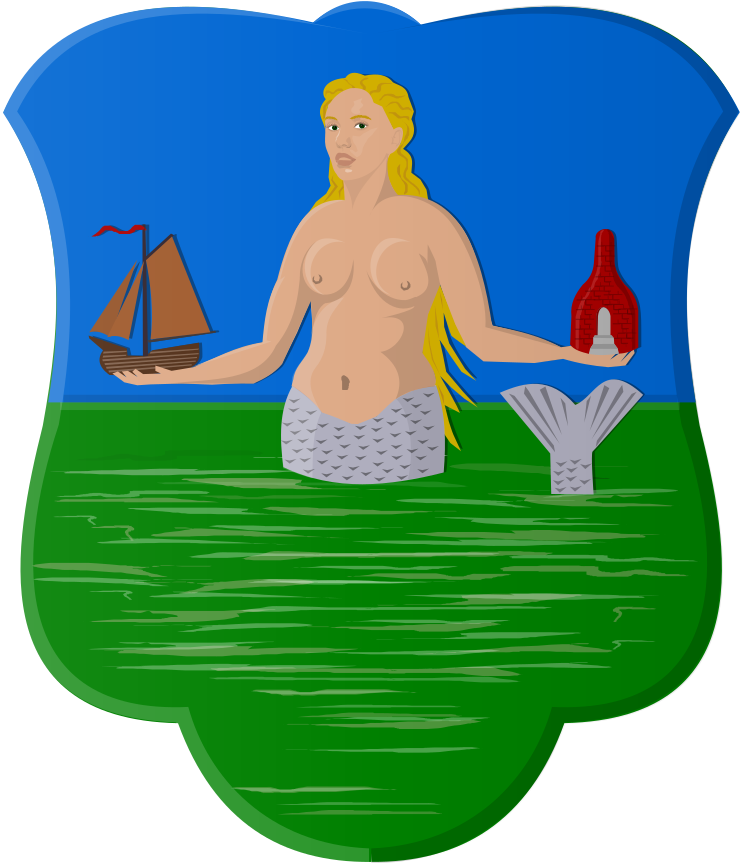
Makkum lies on the IJsselmeer, which here was the Zuiderzee for centuries. It is a village with the face of a town: a weigh house like a tower, merchants’ houses along the water, and a coat of arms in which a golden mermaid holds up a ship and a lime kiln. Whoever carries seafaring in his arms carries sailors’ tales as well. In 1896 Waling Dykstra wrote down one of them — about a Makkum skipper whose voyages were so fast that people began to wonder who was helping him.


1 The village that almost became a town
Makkum began as a farming village on a mound beside the Zuiderzee. In the tenth century a monk of the abbey of Fulda called the place Maggenheim; in 1482 it was Mackum. Further south, by the sluices of the Great Zijlroede, dug in 1542, a second settlement grew up: Statum. By the end of the seventeenth century the mound village and the trading place had grown together into one settlement, which kept the name Makkum.
In that same century Makkum was a trading and shipping town of weight, the seaport of Bolsward. There were brickworks, shipyards and above all shell-lime burners: the mortar lime of Makkum went by ship to Amsterdam. In 1698 the weigh house rose on the Waagsteeg, three square storeys under a tented roof with a lantern carrying a clock on each of its four sides. Makkum never received town rights; it remained the village that almost became the twelfth Frisian town. Its arms tell what it lived by: on a blue shield a golden mermaid rises from a green sea, a silver sailing ship in one hand, a silver lime kiln in the other.
2 The gentleman in the red coat
Out of that seafaring come the stories. In 1896 the Frisian writer and folk narrator Waling Dykstra included a legend in the second part of «Uit Friesland’s volksleven van vroeger en later», in the chapter «Werken des duivels», the works of the devil. At Makkum, it begins, there lived in former times a koff skipper, known as a godless man, who made such extraordinarily fast voyages with his ship that people believed he must be helped in it by someone whose help a good-natured Christian would rather do without.
On a return voyage from Riga with a cargo of beams he was sailing before a favourable wind across the North Sea. All morning the crew heard a busy conversation coming from the cabin, as though a whole company were sitting there. That could not be: in mid-ocean nobody had come aboard, and not a single ship had hailed them that day. When the midday meal was ready, the cook sent the ship’s boy down to the cabin. The boy looked round the corner of the door, cried out «oh Lord!» and came back trembling like a reed: a finely dressed gentleman in a red coat was sitting with the captain.
The mate judged this no matter for one man or two; they went at the cabin all together. It was empty. They searched every corner and the captain’s bunk, but he had vanished. Only one cabin port stood open, and from that the mate concluded what had happened: through that opening the gentleman in the red coat had flown away with the skipper. According to tradition, after that voyage no one dared sail on that ship again.
3 The Flying Dutchman and the sugar ship
Makkum also supplied the skipper who survived the Flying Dutchman, at least in the version Josef Cohen printed in 1918 in «Nederlandsche Sagen en Legenden». In the Spanish sea a storm broke; the skipper sat calmly smoking his pipe in his cabin and said only: «Let stand what stands.» When the mate saw the white ghost ship to windward, the pipe flew into the sea. «Then we owe him honour too», said the man from Makkum, «he shall have his honour from the Frisian.» He loaded a swivel gun and let the powder crack. The ghost ship was gone, and the crew came safely home.
Nearer home lives the story of the sugar ship. Roughly a hundred years before S. Altena of Makkum told it in 1962 to the collector E. Wouda of the Meertens Instituut, a wooden sea tjalk loaded with bales of sugar ran aground on the shallows west of Makkum. The ship broke up and those on board drowned. Fishermen from Makkum brought in what could be brought in; men from Texel came on the rumour, but under the lead of Strong Harmen, Harmen Munniksma, the Makkum men kept the upper hand. Women ran behind the carriers with a knife, slit the sacks open and caught the sugar in their aprons. A saying even grew out of it: mouth shut, father is going to tell about the sugar ship.
The setting of those stories is still there. Since 2003 the weigh house has held the documentation centre of the Ald Makkum foundation, and on the Turfmarkt stands the pottery of Tichelaar, the oldest family firm in the Netherlands. In its office, so S. Bonnema related, there hung in 1962 above the door a tableau of nine tiles bearing the faces of K. Lantinga, a merchant from Workum who according to his neighbours could work magic. In the middle is his own countenance.
- The Strange Racer of Sneek · Sneek
- The Woman in White before Sloten · Sloten
- The shroud of the Workum skippers · Workum

Heimweer.be · Europees Erfgoed Bewaard

