
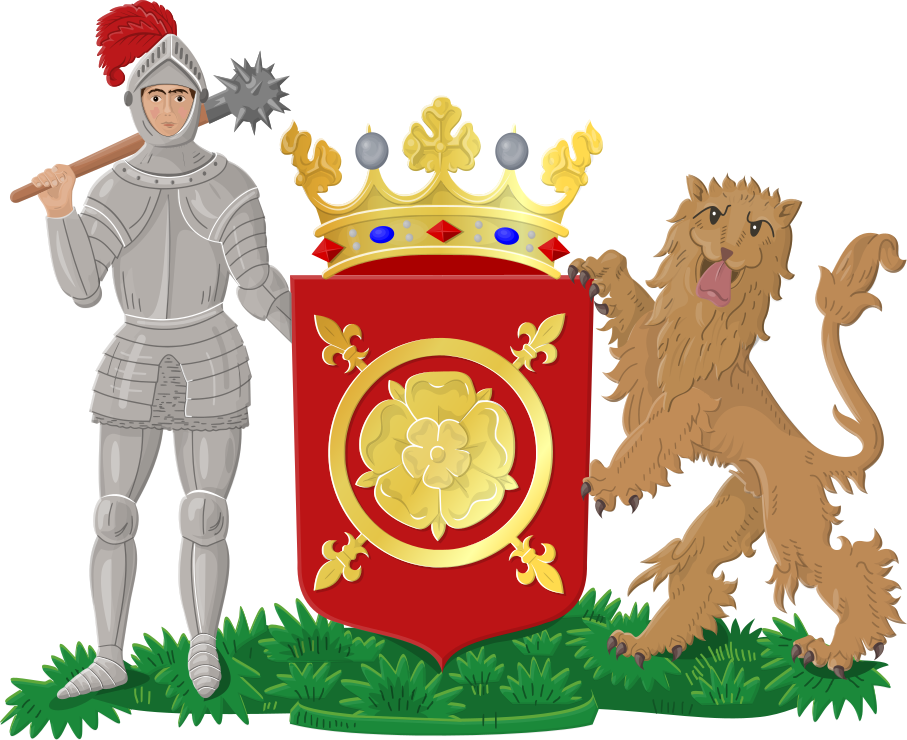
The Wailing in the Towers of Schagen


Whoever walks across the market square of Schagen, in the north of West Friesland, sees two heavy round towers standing behind the houses, and between them a castle that looks newer than its towers. Rightly so: the castle of Schagen was demolished in the nineteenth century and rebuilt only in our own, and anyone who wishes can book a room there today. But the stories that cling to the old stones have never gone away. In the towers, they say, you can hear at night the wailing of men who were tortured there during the Eighty Years’ War. And just outside the centre, the people of Schagen were still telling in the last century of a castle that rises from the ground, shines with light, and sinks away again.


1 The castle of the bastard son
In the Middle Ages Schagen grew into a trading town on the West Frisian Sea Dike and received town rights in 1415. On 29 June 1427 the Count of Holland granted the town and the surrounding Schagercogge in fief to Willem, a bastard son of Duke Albrecht of Bavaria. His descendants called themselves Van Beieren van Schagen from then on, and Willem, who went down in history as Willem the Bastard, had an existing stone house converted around 1440 into a true moated castle: a square stronghold in its moat, with a residential wing between two square corner towers and, on the north side, a gate tower with a drawbridge, flanked by two round towers. Around it lay gardens, orchards and planted lanes.
For more than two centuries the castle stayed in the family. In 1658 the last heir, forced by debts, had to sell the lordship, castle and all, to George van Cats for 263,000 guilders. Van Cats had the gate tower and front wall pulled down, giving the castle an open face. In 1676 a descendant of the old line, Floris Carel van Beieren van Schagen, bought everything back, but he lived in a castle in Belgium and the house stood empty from then on. It was damaged during the Anglo-Russian invasion of 1799, and around 1820 the ruin came down. Only the two round towers remained, thanks to the municipality, which installed a prison and a jailer’s dwelling in them.
2 Sonoy’s blood council
The darkest page of the castle falls in the Eighty Years’ War. In those years it housed Diederik Sonoy, born in Kalkar in 1529, a leader of the Sea Beggars and from 1572 governor of the Northern Quarter in the name of William of Orange. His record was impressive: in 1573 the Beggars under his command flooded the land around Alkmaar, so that the Spanish siege failed, and shortly afterwards the Spaniards also lost the Battle of the Zuiderzee.
But the same Sonoy ran a reign of terror against the Catholics of his region. He was responsible for the deaths of the martyrs of Alkmaar and of Ransdorp, and in the towers of the castle of Schagen his tribunal, which tradition calls the blood council, had farmers tortured who were accused of siding with the Spaniards. The historian Henk van Nierop has described those trials in his book on the treason of the Northern Quarter: confessions were forced on the rack, and more than one suspect died innocent.
Out of that horror the legend grew. Whoever stands by the towers at night, so they tell in Schagen, can still hear the wailing of the men who were tortured there four hundred and fifty years ago. The story was written down in the twentieth century in the literature on haunted castles, and the rebuilt castle is not afraid of it: anyone who dares can simply spend the night there, one floor above the old towers.
3 The castle that sinks away
Schagen knows a second castle legend, and it is set not at the castle but on a lane just outside the old centre, bearing the curious name Schimmelruiterlaantje, the lane of the rider on the grey horse. On 28 April 1964 collectors wrote down there, from the mouth of an inhabitant, a story that is preserved in the Dutch Folktale Database of the Meertens Institute.
On that lane, where a maze had stood decades earlier, a castle was said to have sunk into the ground. At night people suddenly saw it standing there again, tall and high, with all its rooms brightly lit. Sometimes a window opened and a woman shook out her bedding, so that the feathers flew all around. Then the castle sank away again, and the lane lay dark and silent as if nothing had ever stood there.
Folklorists recognise in this a tale type told all over Europe, that of the sunken castle which becomes visible at set times. In Schagen it took on a homely colour of its own: no cursed knight, no ghostly procession, but a housewife airing her beds. So the town keeps its two castles: one of stone, rebuilt and inhabited, through whose towers the wailing of Sonoy’s victims is said to drift, and one of air and light, which exists only for those who pass the Schimmelruiterlaantje at the right hour.
- The King Beneath the Hearth · Hoogwoud
- The farmer with the devil’s book · Berkhout

Heimweer.be · Europees Erfgoed Bewaard

