
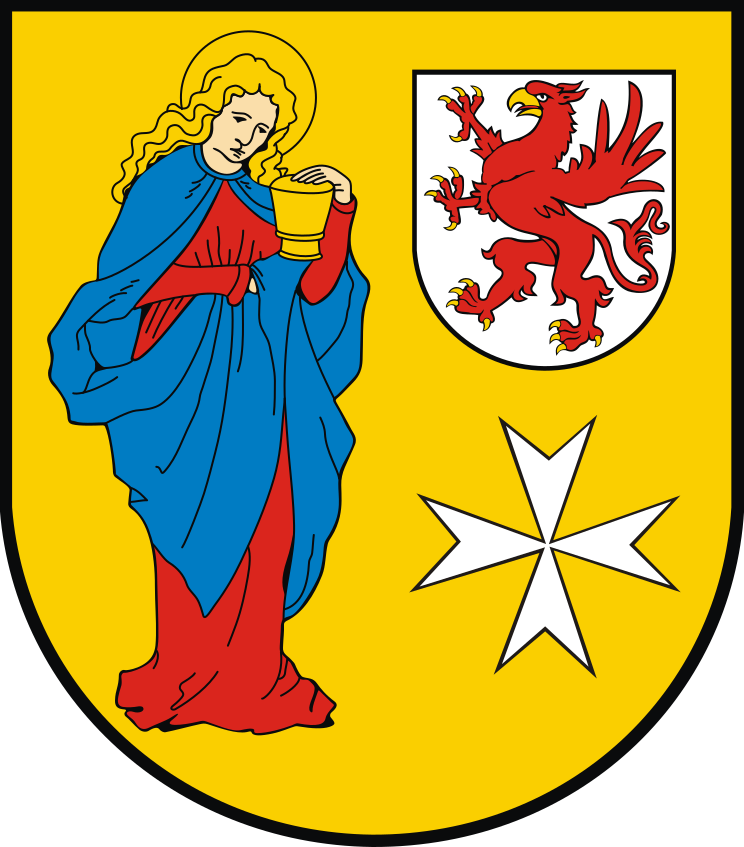
The Passion Play of Banie


In Pomerania, when something that begins merrily ends in misery, people say: ‘That goes like the play at Banie.’ Behind the saying lies a tale from the days when Banie (Bahne), south of Szczecin, was still a prosperous, walled town where the suffering of Christ was performed every year.


1 A town that played
Banie is a quiet village today, set among fields and lakes, but it was once a good, strong town with walls and gates. While the town was still flourishing, the Passion was played there every year: the story of Christ’s suffering, from the betrayal to the crucifixion. Townsfolk took the parts, and many people came to watch, from the town itself and from far beyond.
Such a play was more than entertainment. It was faith you could see with your own eyes, a feast that filled the streets with stalls, pilgrims and onlookers. For a small town it meant honour, and money too. So everything was done to make it look as real as possible. The man who played Jesus wore a bladder of blood beneath his robe, so that when the captain Longinus thrust his spear, real blood would flow before the eyes of the crowd.
2 The spear thrust
One year it happened that the man who was to be Jesus and the man who was to play the captain Longinus were mortal enemies. Why, the old chronicle does not say. They stood together on the stage, one on the cross, the other below it with the spear in his hand.
When the moment came for Longinus to pierce the bladder of blood, he did not pierce the bladder. He drove the spear straight through, into his enemy’s heart. The man was dead on the instant. He fell from the cross, and in falling he struck the woman playing Mary beneath it. She too fell down dead.
John had seen it all. He was a friend of the man who played Jesus and of the woman who was Mary, and in horror and rage he threw himself on Longinus at once and strangled him. The crowd tried to seize John. He fled, leapt from a wall of the town and broke both his legs in the jump. So they caught him after all. He was condemned as a murderer and broken on the wheel.
3 Like the play at Banie
Four lives that single play had cost. From that day on no Passion was ever played again in Banie. The stalls stayed away, and so did the pilgrims, and the town grew quieter.
The Pomeranian historian Thomas Kantzow, who wrote the story down in the sixteenth century, also recorded the saying that came from it. In the region itself people said it in Low German: ‘Dat geit tau as dat Späl tom Bahn’. It was used for anything that began cheerfully and with good intentions, and ended wretchedly. Later historians place the disaster around 1498 and see it as the reason the plays came to an end.
In the centuries that followed, Banie lost much of its splendour. Wars and fires swept over the town, its walls were pulled down, and in the end a village was left. But in the saying, the town of the Passion play lives on.
- The Pilgrim of Góra Chełmska · Koszalin
- Julin, the Greatest City in Europe · Wolin
- The Holy Walnut Tree of Szczecin · Szczecin

Heimweer.be · Europees Erfgoed Bewaard

