
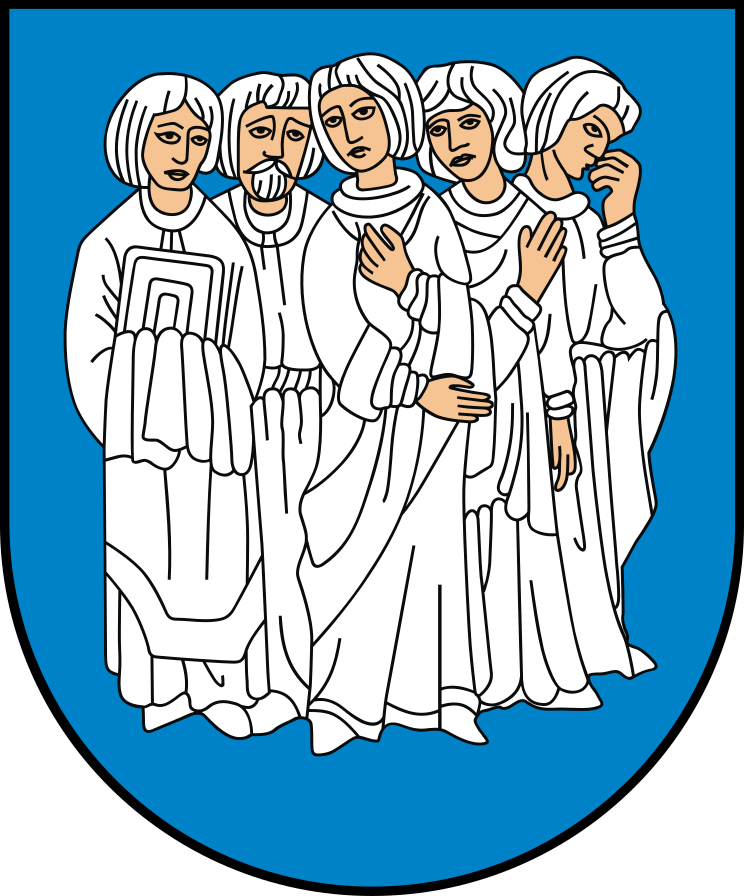
The Five Hermits of Kazimierz


Anyone driving the sandy road from Konin to Kazimierz saw on the left, in the woods on a hill, a deserted monastery, and on the right, close by the road, a crooked wooden chapel of rough planks. Inside lay a little well that stood full of water even in the hottest summer. The walls hung thick with hair: braids, matted plaits, even tufts of horsehair. Berwiński, who wrote the story down, watched his carter, a good local peasant, wash his eyes there. Then the man pulled a handful of hair from his horses’ manes, sprinkled it and hung it on a splinter. Asked why, he told this story.


1 The fish in the well
It happened under our great King Chrobry, who came here to hunt, for it was a wild country of marshes and forests. In that forest lived five hermits, brothers, they say: Jan, Mateusz, Izaak, Krystyn and Barnabasz. Barnabasz was the eldest and the holiest and their superior. He lived apart, just where the chapel with the well stands now. The others lived together, each in a hut of his own. They cleared the forest round their huts into gardens and dressed fieldstones smooth for a church. Those stones, the carter said, still sit among the bricks of the great parish church of Kazimierz.
They lived on roots and a few vegetables. Meat they had sworn never to eat, and fish they could not catch. One noon a butcher from Gniezno came by, an honest, God-fearing man, carrying a piece of meat for his brother. He saw the five at their meagre meal and wanted to give them the meat, but Barnabasz said they ate no meat. Then the butcher wished with all his heart that he were a fisherman. And God turned the meat into a great, splendid fish.
Barnabasz blessed it, cut off the head, roasted the fish and ate it with his brothers and the butcher. The head he lowered into his little well, for a voice in his soul commanded it. The next noon he fished the same fish out of the well, whole and sound. And so it went from then on, every day.
2 The king’s gold
A few years later Chrobry, out hunting, came upon the clearing with its little fields and its four huts. He marvelled at the holy life of the hermits and their zeal in cutting the stones. He saw their poverty and, as a great and open-handed king, gave them all the silver and gold he carried with him and on him. He did not know they had vowed poverty, and they did not tell him. They took it. The courtiers watched and envied them.
When noon came, the four brothers came as always to Barnabasz, who knew nothing. He fished in the well, but drew up only a head on which nothing had grown back. He looked at the ashamed faces of his brothers and said sadly: “Brothers, you have sinned!” They confessed at once and laid heavy penance on themselves.
Barnabasz took the gold and carried it to Gosławice, where the king rested in the evenings after the hunt. There he waited deep into the night. “King,” he said, “you gave them the treasures of this world and took from them the treasure of heaven. Take back what is yours, and pray for us.” The king felt he had done wrong, but he was proud and said the gold was meant for the church. Then Barnabasz began to weep bitterly, and afterwards to smile with joy. “I weep,” he said, “over the punishment that strikes my brothers at this moment, and I rejoice at the happiness that awaits them in heaven.” The courtiers, he saw, had fallen on the sleeping brothers, tortured them for the treasure and murdered them. “Now the last falls, my dearest brother Mateusz.”
3 Fetters that fall
The king sent out archers at once. A great light above the forests showed them the way: the glow of the huts the murderers had set alight. They were running round them as if dazed, not knowing where to flee. That same night they stood bound before the king, who in his anger wanted them put to a cruel death. Barnabasz begged for mercy, but the king had a hard will.
Then Barnabasz fell to his knees and prayed so fervently that God heard him: the fetters dropped from the hands and feet of the guilty. The king recognised the finger of God and left the murderers to Barnabasz. They swore never to leave him again and went with him into the forest. There stood the huts that had burned so brightly, unharmed. The new hermits moved in and did heavy penance. Where the huts stood, chapels like that of Barnabasz still stand today.
Beside this folk tale the book sets the older account of Peter Damian, who wrote the life of Saint Romuald in the eleventh century. There two of the martyrs are called Jan and Benedykt: monks who refused to fetch a crown from Rome with gifts for King Bolesław. Robbers believed they were keeping the gold and murdered them. Their huts would not burn, the robbers wandered all night through the marsh, and the chains with which the king had them fastened to the martyrs’ grave sprang open by themselves.
- Lech and the Eagle’s Nest · Gniezno
- The Tower of the Black Princess in Szamotuły · Szamotuły
- The Beer of Grodzisk · Grodzisk Wielkopolski

Heimweer.be · Europees Erfgoed Bewaard

