
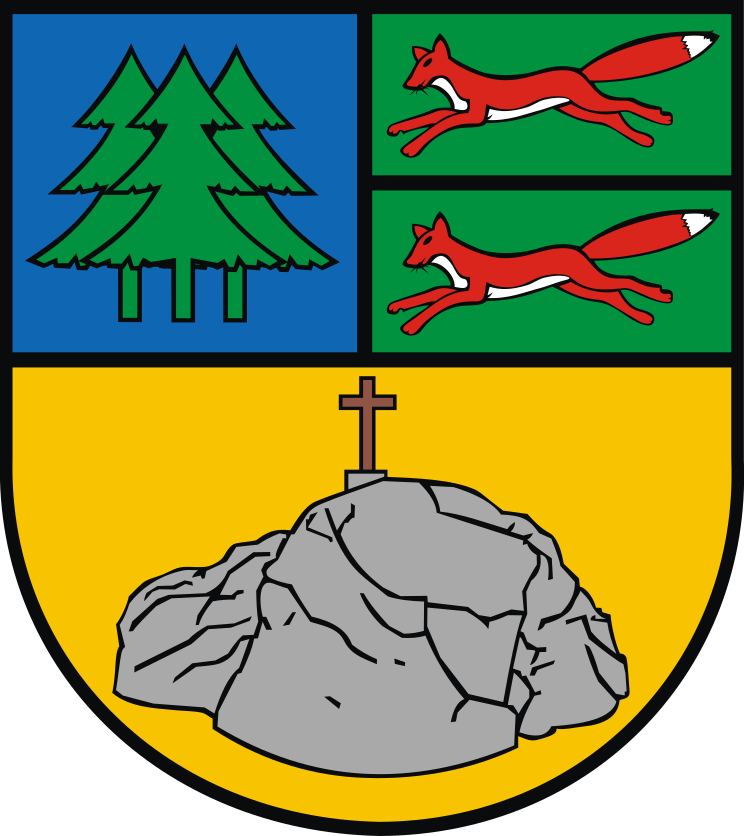
The Devil’s Stone of Tychowo


On the fields of Tychowo (Groß-Tychow), south-east of Białogard (Belgard), lies a stone of enormous size. It reaches as deep into the earth as it rises above it, and still it stands nine feet high. Its top is completely flat, and towards the north-west it slants upwards. Anyone who wants to walk round it must take fifty-four paces, and the carters say that on its top you could turn a wagon with four horses. How did such a stone come to lie there? The people know: the devil threw it.


1 A meeting at Sadkowo
In Tychowo there once lived lords who wanted to make a pact with the devil and sign themselves over to him. They had already become involved with him. The devil had promised them much money and property, and to settle matters properly he had summoned them on a certain night to Sadkowo (Zadkow), three quarters of the way from Tychowo. There they were to meet him on a large stone that lay close to the village.
But as the appointed night drew near, the lords of Tychowo began to have grave misgivings. They saw what a great sin against the good Lord they were about to commit. So they sent for the priest. They confided their trouble to him and asked him to go to the great stone at Sadkowo in their place and tell the devil that they now regretted the whole affair.
The priest was a pious and shrewd man, and he took the matter on. He made the sign of the cross and asked God to stand by him. When the night came, he set off cheerfully towards the stone.
2 The priest and the devil
There he found the devil already waiting for the lords of Tychowo. The clergyman had at first intended to tell the Evil One the whole story straight out and banish him from the district. But standing there all alone before him, his courage failed him after all. He saw that it would be better to take refuge in cunning.
So he put all sorts of feints and evasions to the devil, which the devil could make no proper sense of. He talked and twisted, promised and held back, and in this way he delayed him. The night passed, hour by hour, until all at once the cock in Sadkowo began to crow.
Then the devil realised that he had been tricked. Full of fury, he accused the priest: the lords of Tychowo meant to cheat him. But the priest had now found his courage, and he told him plainly that the lords had repented and wanted nothing more to do with him.
At that the devil glared wildly about him. He grew grim and mad with rage, and at last he picked up the great stone on which he had been standing and hurled it high through the air, to strike the lords in Tychowo dead with it. But in his fury he was clumsy, and the stone broke in two. One piece came down near the village of Borzysław (Burzlaff), half a mile from Sadkowo. The larger piece fell a quarter of a mile further on, close to Tychowo.
3 What remained
The stone at Tychowo still lies there today. The piece that fell at Borzysław was later taken away by a farmer, who made the floor of his barn out of it. And the great hollow in which the stone at Sadkowo once lay can still be seen there. It is called the Fundelkuhle.
Some people tell the story differently. According to them, the devil wanted to carry off the great stone of Sadkowo in a sack. But the mouth of the sack was too narrow, so he first had to break the stone in two. That took him so long that the cock began to crow just as he finished and slung the sack over his neck. He ran with all his might, but the sack tore, and he lost one piece at Borzysław and the other on the field of Tychowo.
People also believe that beneath the stone of Tychowo lies the old heathen idol Triglaff, made of pure gold. The heathens are said to have brought it there from Wolin (Julin) in the days of Bishop Otto of Bamberg, the apostle of the Pomeranians. Others claim that a nobleman from Trzygłów (Triglaff), where the idol had first been taken, hid it there. Once, when he was at war with other noblemen, he had taken the idol with him, and when the enemy pressed him hard, he buried it beneath the great stone so as not to lose it in the fighting.

Heimweer.be · Europees Erfgoed Bewaard

