
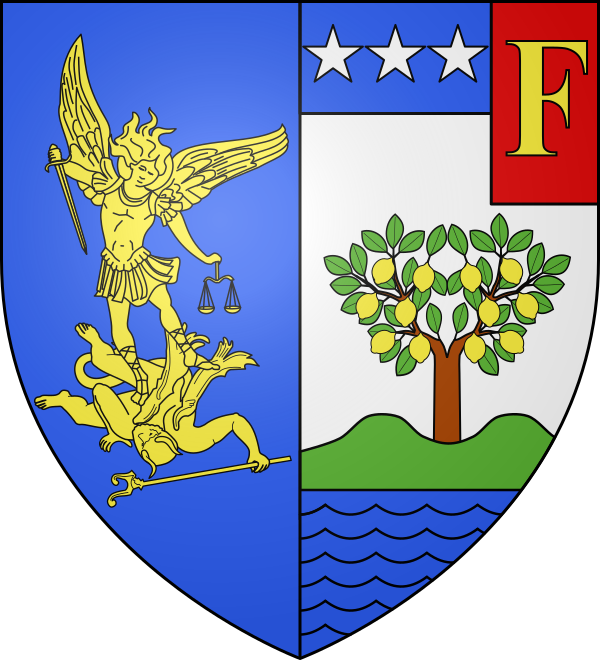
The Lemon of Eve and the Feast of Menton


Menton lies in the very last bend of France, hard against the Italian border, the sea before it and a half-ring of mountains at its back. Anyone arriving in January sees something that would be impossible further inland: trees full of yellow fruit, in the open air, in the middle of winter. The people of Menton have an explanation for this that is older than any meteorology. It comes, they say, from the fact that Eve once passed this way.


1 The fruit in the fold of her cloak
The story goes like this. When the gate of the garden of Eden fell shut behind Adam and Eve, she was carrying something she should not have taken. Not an apple, for that had already been eaten and had brought trouble enough, but a golden fruit she kept hidden in the fold of her cloak: a lemon. She had not been able to bring herself to leave everything behind.
Adam took fright when he saw the yellow light burning under her cloak. Throw it away, he said, before anyone notices. We have been punished once already; let there be no second punishment. But Eve answered that she would neither throw the fruit away nor eat it. She would plant it, and in the first place on earth that resembled the garden they had come from.
So began a long journey along coasts and over passes. Everywhere Eve looked about her and shook her head: too cold, too dry, too bare. Until she stopped above a bay where the mountains opened towards the south, where the light lay on the water like a second sky, and where the winter brought no frost. Here, she said. She dug with her hands into the warm earth and laid the lemon in it.
It is a folk tale, not a chronicle; no medieval document knows it. And yet it really has been played in Menton: on 20 April 1933 a «Legend of the Lemon» was performed in the gardens of the Riviera-Palace, with Eve and her fruit.
2 The mountains that hold back the north wind
Lay the legend beside the map and it is clear that Eve looked well. Behind the town stand Mont Agel, Mont Ours and the Roc d’Orméa, spurs of the Préalpes de Nice, all three above a thousand metres. Together they form a half-circle open to the south. The cold north wind strikes them and passes over; the sun falls all day into the bowl; the sea below keeps the temperature even. The winters stay mild, the summer air stays humid, and the sandstone gives an airy, slightly alkaline soil.
That is why the lemon tree stands here in open ground where elsewhere it needs glass. It knows no real season: on one and the same branch hang white blossom, green buttons and ripe fruit at once, all the year round. This far north that happens almost nowhere else.
The lemon tree is named at Menton as early as 1471. Around 1800 eighty thousand of them were counted, and crates of Menton lemons went by ship to Russia, to the far north of Europe and as far as America, for the fruit kept for weeks. In 1848 the town even rose against the prince of Monaco, who levied a tax on the export of lemons; Menton broke away and became French in 1861.
Then came nights of frost and disease, and the orchards emptied. From 1992 planting began again. On 21 September 2015 the lemon of Menton received a protected geographical indication.
3 The feast, the stairs and the gardens
Menton celebrates that fruit. Carnival has run there since 1875; in 1928 an exhibition of citrus fruit was held for the first time in a hotel garden, and in the nineteen-thirties the whole thing took the name Fête du Citron. Since 1936 the Jardins Biovès have been rebuilt for it, the broad avenue running inland from the sea. There figures of several metres rise up, built as a frame of iron wire with garlands of box, on which the fruits are fastened one by one with a rubber band. Some hundred and forty tonnes of citrus go into it, a million rubber bands and a fortnight of work by about a hundred pairs of hands. Afterwards the fruit is sold off cheaply. In the war years and in 1991 the feast did not take place; in 2019 it was entered in the French inventory of intangible heritage.
Above the noise of the feast lies the old town, a stacking of tall houses and narrow stepped streets. Broad ramps of stairs lead up to the pebbled forecourt of the basilica of Saint-Michel-Archange, built between 1639 and 1653, with a bell tower of fifty-three metres from the years 1701 to 1703.
And then there are the gardens. The Serre de la Madone, laid out from 1924 by Lawrence Johnston on a slope of lemon and olive trees. The Val Rahmeh, with its date palms and old olives. And the park of the palais Carnolès, holding the largest citrus collection in France. Whoever walks there in February smells blossom and thinks of Eve.
- The Devil and the Cut Tail of Coaraze · Coaraze
- The Devil’s Marvels above Tende · Tende

Heimweer.be · Europees Erfgoed Bewaard

