
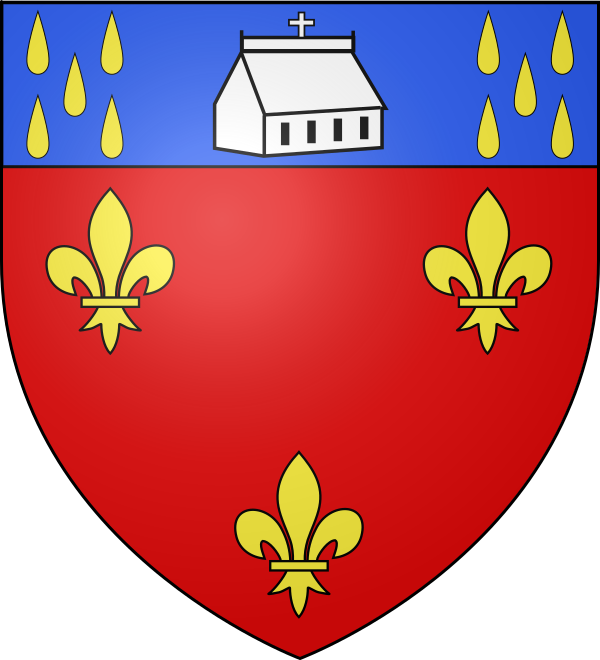
Mary Magdalene on the Hill of Vézelay


Above the valley of the Cure in Burgundy rises a hill the French call la colline éternelle, the eternal hill. On top stands the basilica of Sainte-Marie-Madeleine, and in its crypt stands a reliquary that the abbey claimed from the eleventh century onward to hold the bones of Mary Magdalene. How those relics reached Burgundy is the story of a pious theft — told by the monks themselves as a rescue.


1 The monk sent to fetch a saint
About 858 Count Girart of Roussillon and his wife Berthe founded a monastery in the valley of the Cure. When Norsemen made the plain unsafe, the monks moved in 873 to the crown of the hill above it. For two centuries it remained an abbey like many others.
What made Vézelay famous was a grave that was not there. Tradition says that in the ninth century the abbot sent a monk named Badilon to Saint-Maximin in Provence, where Mary Magdalene was said to lie buried after the sea crossing that the south of France preserves in legends of its own. The Saracens threatened the coast; Badilon opened the tomb, took the bones and carried them north. The monastic chronicle calls this no theft but a rescue: the saint wished to move, or she would have made her bones too heavy to lift.
Little of this can be proved. No text before the year 1000 mentions the relics. Only about 1037 do the monks show them to pilgrims, about 1050 Mary Magdalene becomes patroness of the abbey, and in 1058 Pope Stephen IX confirms by bull that Vézelay possesses her body. The bull is documented; what it asserts remains belief.
2 The hill where crusades began
Papal recognition turned the hill into one of the great pilgrimage sites of the West. Vézelay also became the starting point of the Via Lemovicensis, one of the four French main roads to Santiago de Compostela. Whoever came from Flanders or the Rhineland climbed the village street and began at the church door the walk to Galicia.
So many people demanded a larger church. In 1120 lightning struck and the nave burned out, shortly before the feast of the Magdalene, while the village was full of pilgrims. The abbey rebuilt on a wider scale: a Romanesque nave with alternating light and dark voussoirs, and in the narthex a tympanum of the years 1120-1140 on which Christ with outstretched hands sends the Spirit upon the apostles.
On Easter Sunday, 31 March 1146, Bernard of Clairvaux stood on the northern slope of the hill, because no church could hold the crowd, and preached the Second Crusade. King Louis VII took the cross there. Forty-four years later, in 1190, Richard the Lionheart and Philip II Augustus gathered their armies here for the Third Crusade.
3 The light and the doubt
The end came from Provence. In 1279 Charles of Anjou had the ground opened at Saint-Maximin and found a sarcophagus recognised, with papal assent, as the true tomb of the Magdalene. The argument was painfully simple: if the body still lay there, Badilon had never taken anything. The pilgrims chose the south. Vézelay grew poor, Huguenots plundered the church in 1569, the Revolution pulled down what remained, and about 1830 the nave was close to collapse.
In 1840 an architect of twenty-six was given the task of saving what still stood: Eugène Viollet-le-Duc. He worked on it for nearly twenty years. His interventions are still criticised, because he restored not what was there but what in his view ought to have been — yet the church stands because of him.
Around the summer solstice something happens in that nave that visitors read as a sign. Towards midday the light falls through the high southern windows in nine round patches lying exactly on the central axis of the nave and moving slowly towards the choir. Anyone who works out the sun’s position sees that the orientation of the building and the placing of the windows are enough to explain it; whether the builders intended it has never been proved. In 1920 the church received the title of basilica, and in 1979 hill and basilica entered the UNESCO World Heritage list.

Heimweer.be · Europees Erfgoed Bewaard

