
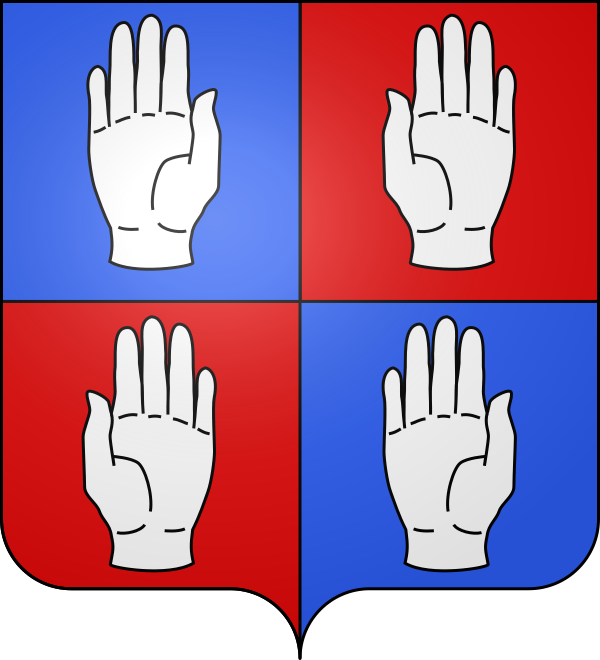
Manosque the Modest


On a hill above the Durance, in Haute-Provence, lies Manosque, the largest town of its department. Its old town has the shape of a pear, girdled by boulevards that took the place of the ramparts ; two gates still stand, the Saunerie and the Soubeyran. People readily call it the town of Jean Giono, yet it carries an older and stranger nickname : Manosque the Modest. To understand it one must go back to a winter morning in 1516, when a king of twenty-one rode through the town gate and a girl chose to disfigure herself rather than please him.


1 The town of four gates
Manosque calls itself a thousand-year-old town, and so it is. Its name, written Maneasq, already appears in the History of the Franks by Gregory of Tours ; under the Romans the place was known for its great regional market. In 982 William the Liberator, first count of Provence, held court here in a castle raised on the summit of the Mont d’Or, of which only a stretch of wall and a ruined tower remain.
From the twelfth century the Order of Saint John of Jerusalem settled in the town ; on the death of the last count of Forcalquier, in 1209, the Hospitallers became its lords and remained so until 1790. When the great companies ravaged Provence, Manosque closed itself off : between 1366 and 1383 it girded itself with a new wall, and its gates took their present form. Four guarded the entrances ; two survive, the Saunerie to the south and the Soubeyran to the north.
It was not the town’s first nickname. A legend has it that in the spring of 1370 Queen Joanna, charmed by the almond trees in blossom, christened it Manosque the Flowering. An earthquake shook it again in 1509. Then came the winter of 1516, and with it the story that would give the town its most lasting name.
2 The sulphur fumes
On 17 January 1516 King Francis I passed through Manosque. He was twenty-one, returning from Italy where he had just triumphed at Marignano, and he was going up the Durance. As custom required, the keys of the town were presented to him ; it was the consul’s daughter who was charged with it, a girl whom tradition calls Péronne de Voland, also named Magdeleine. She stepped forward and spoke her word of welcome.
The prince’s gaze, it is said, rested on her with too much admiration, and that favour alarmed her. The king had a name for gallantry, and she feared she would not be able to escape his desire. Rather than yield, she chose to destroy what exposed her, the freshness of her complexion : she held her face over sulphur fumes until its beauty was ruined.
The gesture is extreme, and it struck people. It is told that the king, far from taking offence, was deeply moved, and heaped favours on the girl and her family. It is from this episode, says the legend, that Manosque takes its nickname : the Modest. The Flowering of Queen Joanna gave way to a graver word.
3 What the legend keeps
Here honesty must be cautious. No document of the time preserves the scene ; the story only takes firm shape much later, and the versions diverge. One insists on outraged modesty and sacrifice ; the other on the generosity of a moved king. Of Péronne de Voland herself history keeps almost nothing certain. The legend must be read as a legend, not as a chronicle.
The nickname, though, has stayed. It travelled through the centuries with the town, like a somewhat severe companion. Yet Manosque has surer claims to fame : here, in March 1895, the writer Jean Giono was born, who lived here and died here in 1970, and who set part of The Horseman on the Roof in its streets, in the time of the cholera of 1834.
Whoever comes to Manosque today walks through the pear-shaped old town, passes under the Soubeyran with its bell turret added in 1830, and then under the Saunerie. Between the tall houses and the narrow lanes the old nickname can still be heard. The town was flowering ; it wished to be modest ; it remains, above all, Provencal.
- Judith Andrau and the Cauldron of Castellane · Castellane
- The Star of Moustiers · Moustiers-Sainte-Marie

Heimweer.be · Europees Erfgoed Bewaard

