
The Foal of Pézenas and the King’s Mare


On the Peyne, in the plain of the Hérault, lies Pézenas : a small town that was, in the days of the fairs and the Estates of Languedoc, one of the richest in Lower Languedoc, and that keeps from that past its private mansions and the memory of Molière. Yet what it most likes to walk through its streets is neither a king nor a poet : it is a horse of blue cloth strewn with stars, tall as a house, that nine men carry through the town. They call it the Foal, and it was born, so they say, of a mare that king Louis VIII left dying at Pézenas in 1226.


1 The town of fairs and of Molière
Pézenas became a royal town in 1262, when the Salvignac family sold the lordships of Pézenas and Tourbes to king Louis IX for three thousand livres tournois. The fairs, given over to wool and cloth, made its fortune : Jacques Cœur kept a trading post there, and in 1456 the Estates of Languedoc met in the town for the first time. For two centuries the small town weighed in the affairs of the province.
The Montmorency governed Languedoc for a century. Henri I had the castle of the Grange des Prés built at the gates of the town. His son Henri II, godson of Henry IV, rose against Richelieu and was beheaded at Toulouse in 1632 ; the cardinal then had the castle that overlooked Pézenas pulled down. The county passed to the Condés and then to the prince of Conti, whose court settled at the Grange des Prés.
It was Conti who invited Molière’s troupe : from 1650 it called itself the prince’s players, and the Estates of Languedoc paid it a subsidy. Molière haunted the shop of the barber Gély, where he found matter for his farces. Louis XIV was received in the town in 1660. Of all this Pézenas keeps a rare quarter of private mansions, one of the first protected old towns in France, and the label town of art and history.
2 The mare of Louis VIII
The story told at Pézenas is about a horse. In 1226, on the road to the crusade, king Louis VIII halts in the town and must leave his sick mare there. On his return he finds her very much alive, and more : she has foaled. To immortalise the happy event the notables had a wooden animal built to walk in the town’s festivals.
On its back they set two cloth figures, Estieinou and Estieineta, a man and a woman. They recall another story : in 1622 a gallant marshal is said to have taken a peasant girl up behind him to help her cross the Peyne, the little river that runs through Pézenas. Two legends, then, carried by the same beast.
And this is where honesty belongs. The mare of 1226 is a fine origin, but nothing attests it : it is a tale, not a record. What is certain is that the Foal ranks, with the camel of Béziers and the donkey of Gignac, among the oldest totem animals of the Hérault, attested from the sixteenth century. Its fame is old too : in 1878 the Felibres of Montpellier wanted it at their Latin Festivals, beside the ox of Mèze and the tarasque of Tarascon, and in 1989 it represented France in India.
3 A totem on the list of the world’s heritage
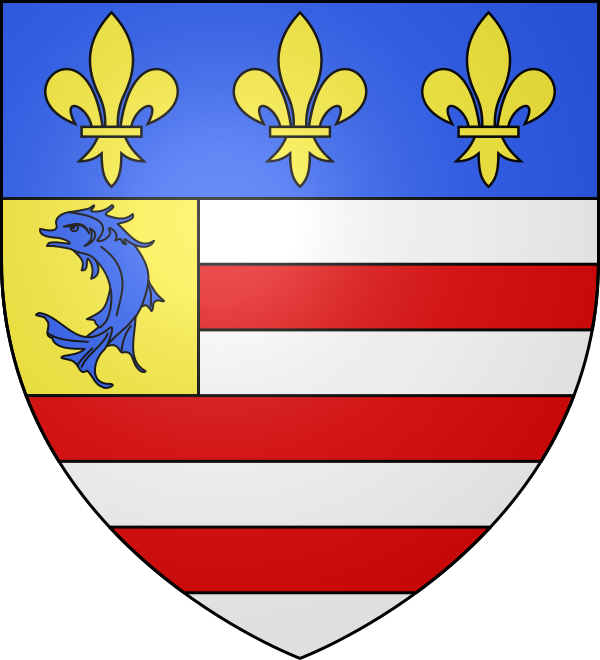
The Foal of today weighs three hundred and sixty kilos. Its frame of chestnut hoops is covered with blue cloth strewn with golden stars and adorned with the arms of the town. Head and neck are movable : all along the parade the animal stretches its neck towards a passer-by or a shop, opens its jaws and closes them again, collecting for the needy.
Inside, nine men carry it and make it dance to the fife, on the air of the Foal ; a leader in a green and red jacket, nicknamed Pampille, guides it. It comes out for Mardi Gras and for the great days of the town. In 2005 UNESCO inscribed the processional giants and dragons of Belgium and France, of which the Foal is one, on the list of the intangible heritage of humanity.
It stands there beside the giants of Ath, Brussels, Dendermonde, Mechelen and Mons, and, for France, beside the festivals of Cassel, Douai and Tarascon. The historians may doubt the mare of 1226 ; Pézenas keeps the foal. Every year the blue horse still dances through the streets where it is said to have been born.
- The Camel of Béziers and the Saint Who Carried His Head · Béziers
- The Moon-Fishers of Lunel · Lunel
- The Devil’s Bridge of Saint-Guilhem · Saint-Guilhem-le-Désert

Heimweer.be · Europees Erfgoed Bewaard

