
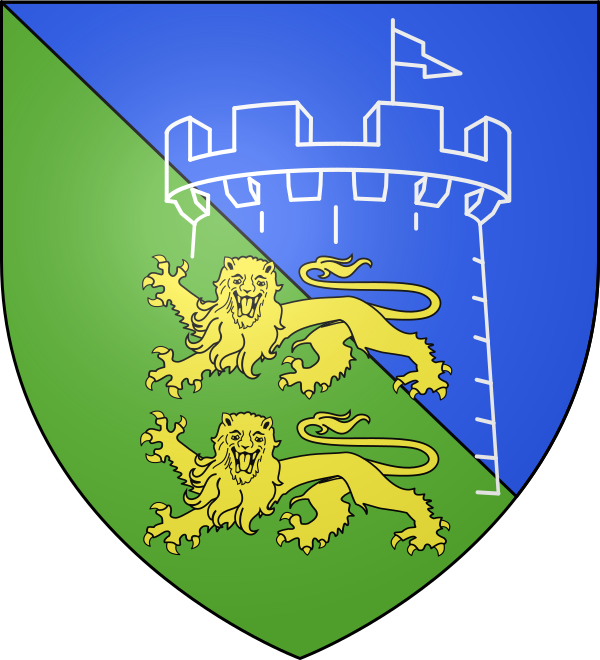
Robert the Devil, the Child of the Pact


On the Seine, downstream of Rouen, the small village of Moulineaux presses against the foot of the forest of La Londe-Rouvray. Above it, on a cliff that commands a bend of the river, stand the ruins of a fortress. It is called the castle of Robert the Devil, after a hero of legend the stone never knew. For behind that name lies one of the darkest tales of the Norman Middle Ages: that of a child born of a pact with Satan.


1 The castle on the cliff
The site is no accident. High on a cliff commanding the left bank of the Seine, the castle watched from far off over the two arms of a bend in the river, downstream of Rouen. It was a lookout post, a watch over the water road. A castle stood here as early as the eleventh century, in the time of the dukes of Normandy, when the Seine valley was one of the great arteries of the duchy.
The history of the stronghold is one of sieges and seizures. John Lackland had it rebuilt between 1202 and 1203; dismantled, it then passed into Capetian hands before major works in the fourteenth century. In March 1365 Charles II, king of Navarre, had to give it back, along with the neighbouring castles, under an agreement made with the king of France. The moats, the keep, the chapel and the curtain wall still trace the plan of this fortress.
But where does the name come from? A local legend attributes the building of the place to Robert the Devil. The historians hesitate: some have wished to see behind this figure Robert the Magnificent, duke of Normandy and father of William the Conqueror, others the fierce Robert II of Bellême, others again Robert Curthose. No proof ties the fortress to any of them, and the oldest ruins go back no further than the thirteenth century. The name came from the legend, not the other way round.
2 The pact and the child
An anonymous poet set this legend into verse at the turn of the twelfth and thirteenth centuries, about 1200, no doubt taking up an older oral tradition. It begins with a misfortune: the wife of Duke Aubert, despairing of ever having a child, at last called on Satan to give her one. The wish was granted. So Robert was born, marked from the cradle by the pact that had summoned him into the world.
The child grew up and became a terror, to his companions and to the whole country. His violence knew no measure, and no one understood where his fury came from. One day, when he was a youth, he wrung the truth from his mother: she confessed to him the diabolic origin of his birth. The shock was such that Robert changed utterly. He resolved to atone, at any cost, for the fault that was not his own.
He left Normandy. On the advice of a hermit he bound himself to absolute silence, passed himself off as a madman, and, to humble himself, shared his food with the dogs. At Rome, where his penance had led him, the emperor noticed him and attached him to his court. Three times, in secret, Robert fought the Saracens and saved the Empire. When he was offered the hand of the emperor’s daughter, he refused: he wished to end his days as a hermit. The monster had become a saint.
3 What the legend left behind
It must be said plainly: nothing proves that Robert the Devil ever existed. The tale holds only a few historical markers, and those contradict one another. Duke Aubert and his wife are figures of a story; the parallels drawn with this or that Norman lord remain fragile. The castle of Moulineaux lent its walls to a hero born of the imagination, and it is from that meeting that it takes its name.
The tale itself had a long life. Spread by the Bibliothèque bleue, it reached the theatre and then the operatic stage: in 1831 Giacomo Meyerbeer staged at the Paris Opera a grand opera entitled Robert le Diable, to a libretto by Eugène Scribe. Franz Liszt made a piano piece of it, and Edgar Degas painted a scene from its ballet. The legend had long since far outgrown the stones that had given it a name.
The stones, however, are still there. Restored from 1903 to 1905 by Lucien Lefort, a pupil of Viollet-le-Duc, the castle was bought and fitted out in the nineteen-fifties by Roger Parment, mayor of Moulineaux, who made it a place to walk to. A fire destroyed its north tower in 2007; the Rouen conurbation bought it and reopened its moats and courtyard to the public. Below, in the village, the thirteenth-century church of Saint-Jacques-le-Majeur still watches over Moulineaux.
- La Gargouille — the Dragon of Rouen · Rouen
- The Chamber of the Damsels of Étretat · Étretat
- The Énervés of Jumièges · Jumièges

Heimweer.be · Europees Erfgoed Bewaard

