
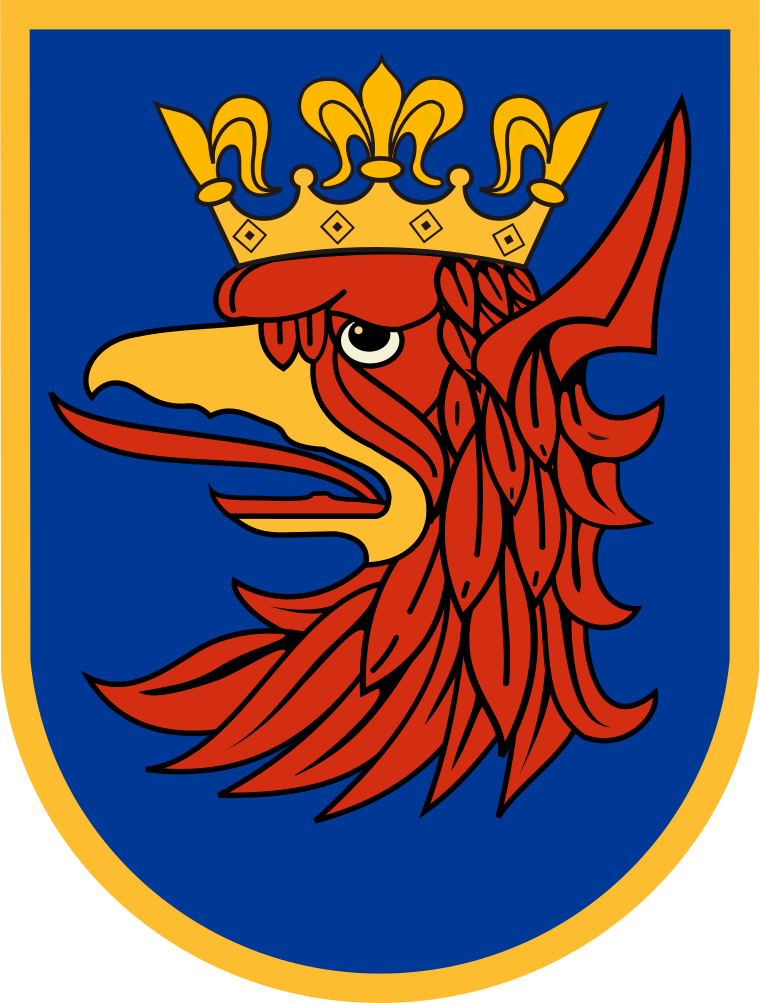
The Griffin of Szczecin


On the blue shield of Szczecin stands the red, crowned head of a griffin. It recalls the dukes who for centuries held court in the city on the Oder: the House of Griffins, the Greifen of Pomerania. How that house came to its end was told in Pomerania in a string of dark legends.


1 The house of the griffin
For centuries the dukes of Pomerania ruled from Stettin, as Szczecin was then called, and in their arms they bore the griffin. In 1573 Duke Barnim IX died at the Oderburg, the graceful and strong castle he had built before the town. He had lived to seventy-two and reigned for fifty years, so gentle and godly that people called him the father of the fatherland.
On the night of his death a strange wonder took place. The many gilded weathercocks and finials that adorned the castle all turned black at once, though there had been neither thunder nor rain that night. It was as if the building itself mourned its lord. From then on, people said, Pomerania had no lucky stars: no duke who ruled in Stettin after him was blessed with an heir, neither son nor daughter.
2 The curse of Sidonia
The people knew well why. At the courts of Wolgast and Stettin lived a noble maiden, Sidonia von Borcke, uncommonly beautiful, rich and of high birth. Duke Ernst Ludwig of Wolgast fell so deeply in love with her that he meant to marry her at any cost. But the princes of Stettin would not allow it and saw to it that he wed a princess of Brunswick.
Then Sidonia flew into a great rage. She bewitched the six young princes who lived in Stettin at the time, all with young wives, so that they must die without heirs. Afterwards she withdrew to the convent of Marienfließ, where, the legend says, she went on with her sorcery, helped by a little spirit that mostly took the shape of a cat. Only when she was nearly eighty did it all come out. Under torture she confessed, and in 1620 she was beheaded and burned before the Mill Gate of Stettin. The spell against the princes, she confessed, she had locked in a padlock and sunk in the lake at Marienfließ. Yet many also held her innocent: a curious, quarrelsome woman who confessed only under torture.
3 The last signs
Meanwhile the omens piled up. In 1616 a storm in Stettin tore the finial from the castle church of St Otto and bent its spikes, and soon after the six young princes died one after another. In 1625, at a muster in Wolgast, a soldier’s gun went off by chance, and the bullet cut the Pomeranian arms out of the banner as if with scissors. At the same moment the ducal crown in the castle church of Stettin fell to the ground of its own accord, and an armoured stone figure dropped its sword without any human hand.
In February 1637, at three in the morning, a white patch was seen in the northern sky above Stettin with a great lump of fire in it, which fell beside the windmills and scorched the winter corn. Exactly fourteen days later Bogislaw XIV, the last duke, died. Weeks afterwards the preachers of St James saw the sun without rays, crossed by a black beam, until it turned red as dark blood. The House of Griffins was extinct. Only the griffin itself remained: red and crowned, it still stands in the arms of Szczecin.
- The Holy Walnut Tree of Szczecin · Szczecin
- The Bloodstains in St James’s Church in Szczecin · Szczecin
- The Shepherd Girl of St Gertrude’s Church in Szczecin · Szczecin

Heimweer.be · Europees Erfgoed Bewaard

