
Charles Martel and the Town of the Three Hammers


On a plateau of the Causse, in the north of the Lot, stands Martel : a small town of pale golden stone that people call the town of the seven towers. From afar it looks out over the valley of the Dordogne, between the Limousin and the Quercy, where once the royal road from Paris to Toulouse and the salt road crossed. Tradition gives it a Carolingian hero for a godfather, Charles Martel, and three hammers for a coat of arms. History tells something else ; but at Martel the legend and the stones have in the end joined hands.


1 The hammer and the name
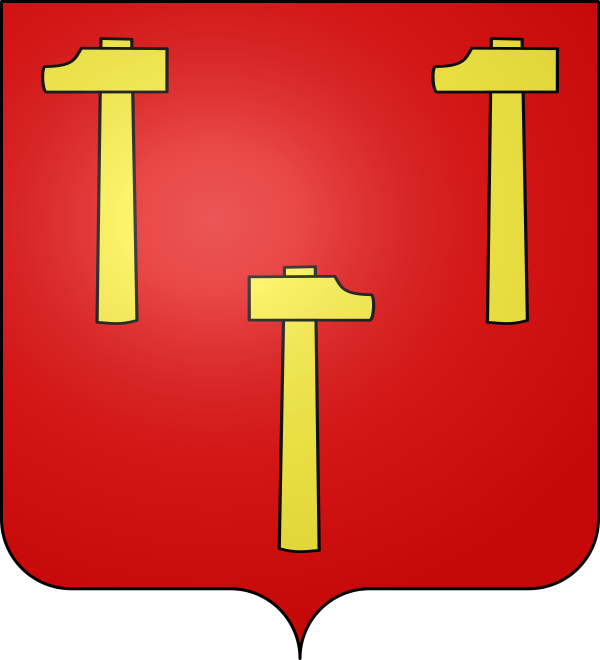
At Martel they say the town owes its name to Charles Martel, mayor of the palace and grandfather of Charlemagne. After the battle of Poitiers, in 732, the Frankish leader is said to have pursued the Saracens southward and crushed them close by, at Loupchat, in 733. In thanks for that victory he is said to have founded a town around a church dedicated to Saint Maurus, and marked it with three hammers, those with which he struck his enemies as on an anvil.
The story is a fine one, and it explains everything : the name, the church, the arms. The historian Pierre Riché even defended the idea that the nickname Martel, hammer in Old French and Occitan, arose from that rout of the Muslim troops. But the nickname was given to the Frankish leader only after his death, and the town itself was not built until three centuries later.
No manuscript links Martel to Charles Martel before the sixteenth century. The connection was forged late, then taken up again in the nineteenth century, in an age that liked to give towns a glorious origin. The three hammers of the arms probably have a humbler cause : the forges that worked here, the Faurie, and the iron merchants who made the town’s first fortune.
2 A town born of a crossroads
The real Martel was born in the eleventh century, not of a battle but of a crossroads. On this plateau the old road from Paris to the south crossed the salt road that climbed from the Dordogne toward the Auvergne. The Benedictine abbey of Souillac set up a salt market there, under the double protection of the viscounts of Turenne and of Brassac. Around that market servants of the abbey became craftsmen and merchants, and a small town grew up.
In 1183 Raymond II of Turenne bought the viscounty of Brassac and became sole lord of the town. That same year Martel entered the wider history : Henry the Young King, the rebellious son of Henry II of England and Eleanor of Aquitaine, died there in the house of the burgher Étienne Fabri, returning from the sack of Rocamadour. In 1219 the inhabitants obtained from the viscount a charter of franchises exempting them from taxes : the beginning of their first golden age.
Governed by four consuls elected each year, Martel prospered on grain, salt and cattle. During the Hundred Years’ War, caught between English Aquitaine and the king of France, it ringed itself with ramparts and towers. It was never taken by arms : its consuls knew how to buy peace when they had to, where neighbours such as Gramat fell.
3 The town of the seven towers
The name town of the seven towers comes from the seventeenth century. Of the thirty or so towers the town counted, seven rose above the plateau : the bell tower of the church of Saint-Maur, the belfry of the Hôtel de la Raymondie, the Tournemire tower that served as a prison, and those of the Cordeliers, of Fabri, of Briance and of Mirandol. They were later tied to an allegory of the seven virtues, devised for the solemn reception of the viscountess of Turenne in 1615.
At the heart of the town opens the square lined by the palace of the Raymondie, built around 1280 by a wealthy burgher and later become the town hall. Close by, the covered market of the eighteenth century still keeps its chestnut-wood roof frame and its conques, those grain measures hollowed out of stone. The fortified church of Saint-Maur raises its Gothic bell tower to more than forty metres : a fine example of the Gothic of the Midi.
Long a market for salt and cattle, Martel became in the nineteenth century a capital of the truffle ; at the Christmas market of 1904 more than twenty tonnes of black gold changed hands. Today counted among the Plus Beaux Villages de France, the town has kept its three hammers and its legend. The historians are right to correct it ; Martel has the story.
- Durandal, the Sword in the Cliff of Rocamadour · Rocamadour
- The Devil and Saint Martin’s Mule · Padirac
- The Devil of the Pont Valentré · Cahors

Heimweer.be · Europees Erfgoed Bewaard

